
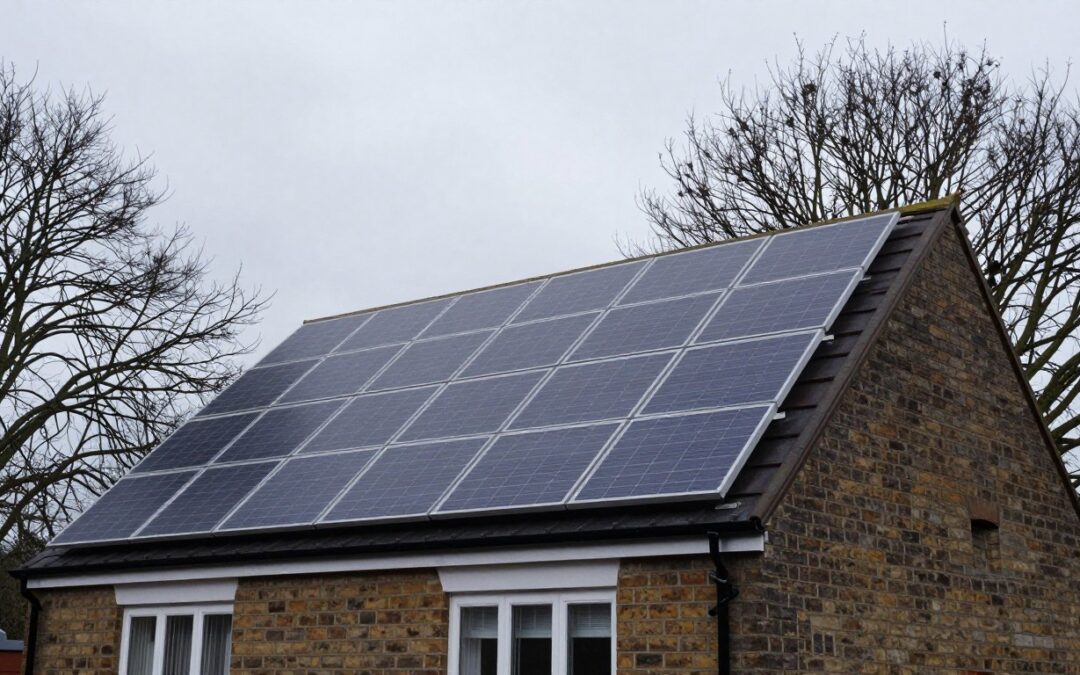
The number one question people ask before buying a plug-in solar kit is some version of: “but what about winter?” It is a fair concern. The UK is not famous for its sunny skies, and the idea of spending several hundred pounds on solar panels that sit doing nothing through November and February gives people pause.
The honest answer is that winter output is real, useful, and worth having — but it is significantly less than summer, and whether your system makes good use of the daylight it does get depends almost entirely on how and where you position your panels. Get that right and your plug-in system earns money twelve months a year. Get it wrong and winter becomes genuinely disappointing.
This article covers the actual numbers, what happens to output in winter, and the specific placement decisions that make the biggest difference.
What the data actually shows
A typical 400W solar panel in the UK generates around 35 to 55 kilowatt hours per month averaged across the year. In the peak summer months of May, June and July, that same panel can generate significantly more. In December and January, considerably less.
The seasonal swing is larger than most people expect. Data from solar monitoring across UK installations shows that a south-facing system produces around 29 kWh per installed kilowatt in December, compared to roughly 119 kWh per kilowatt in May. That is a ratio of about four to one between the best and worst months. Across the winter quarter of November through February, you can expect roughly 15 to 25 percent of your annual generation, depending on location.
For an 800W plug-in system generating around 600 kWh per year in a good south-facing position in central England, that works out to roughly 90 to 150 kWh across the winter months — perhaps £25 to £42 in electricity at current rates. Not transformative, but not nothing either. The fridge is still running, the router is still on, and some of that base load is still being offset every day there is usable daylight.
Cold does not hurt panels — in fact it slightly helps
One thing worth understanding before we talk about placement is that solar panels do not generate electricity from heat. They generate it from light. Cold temperatures actually improve the efficiency of photovoltaic cells slightly compared to hot conditions. A cold, bright January day with clear skies will produce noticeably more output than a warm, hazy August afternoon with the same amount of cloud cover.
What winter does reduce is the number of hours of usable daylight and the angle at which sunlight reaches your panels. In December, the sun rises late, stays low in the sky, and sets early. In London, you get around seven to eight hours of daylight in December compared to sixteen in June. The sun’s path is also much shallower, meaning it spends most of the day at a low angle rather than climbing high overhead. Both of these factors reduce generation — but neither of them is fixed. And that is where panel placement becomes critical.
Why placement matters more in winter than summer
In summer, the UK sun climbs high enough in the sky that panels in a fairly wide range of orientations and angles will capture reasonable amounts of light. Even an east or west-facing panel on a balcony railing will generate something useful during the long summer days.
Winter is less forgiving. The sun stays low. This means that panels facing away from south receive far less light, panels with a shallow tilt angle miss much of the available sunlight, and any shading from nearby trees, walls or buildings — which cast much longer shadows in winter — can wipe out a significant portion of your output.
The difference between a well-placed panel and a poorly placed one is far larger in December than it is in July. Getting placement right is worth far more than upgrading to a more expensive panel.
The south-facing rule and why winter makes it non-negotiable
South-facing panels receive the most direct sunlight throughout the year in the UK, and this advantage is most pronounced in winter. When the sun is low in the southern sky, a south-facing panel is pointing almost directly at it. An east or west-facing panel is pointing roughly 90 degrees away from the sun’s position for most of the day.
The practical output difference is significant. In summer, an east or west-facing panel produces around 60 to 70 percent of what a south-facing panel would generate. In winter, that gap widens. The low sun angle means east and west-facing panels may only capture usable light for a fraction of the already short winter day.
If your only available outdoor space faces east or west, plug-in solar still makes financial sense overall — the strong summer months more than compensate. But if you have any flexibility in where you place your panels, south-facing is not just a preference in winter. It is the difference between a system that generates something useful on a clear December day and one that barely registers.
North-facing is not worth attempting at any time of year. In winter it is essentially non-functional for UK solar generation. If north-facing is your only option, our FAQ page covers the alternatives worth considering before spending money on a kit.
Tilt angle: the winter variable most people ignore
The other placement factor that matters enormously in winter is tilt angle — how steeply your panels are angled toward the sky.
The optimal tilt for year-round generation in the UK is around 35 to 40 degrees. This is the angle that captures the best average of summer and winter sun paths. At this angle, panels are not pointing directly at the sun in either season, but they are reasonably well aligned for both.
In winter specifically, a steeper tilt helps considerably. The sun’s path in December sits at roughly 15 to 25 degrees above the horizon at its highest point in the UK. A panel tilted at 35 to 40 degrees is much better aligned to that low sun than a panel mounted vertically or at a shallow angle.
This is the key trade-off for balcony users. A panel mounted vertically on a balcony railing is essentially at 90 degrees — pointing straight at the horizon rather than at the sky. In summer, when the sun climbs high, this misses a significant portion of available light and produces around 70 percent of what a tilted panel would generate. In winter, when the sun barely rises above the horizon, a vertical south-facing panel is actually reasonably well aligned to the low sun. The seasonal difference in tilt performance is smaller than most people expect.
Where the tilt argument really matters is for garden and ground-mounted systems, where you have the freedom to choose any angle you like. A properly tilted ground-mounted frame is the best winter performer of any plug-in solar setup. If you want to maximise winter generation specifically, a south-facing ground-mounted frame at 40 to 50 degrees is your best option. Our guide to balcony vs garden solar covers the practical setup options in more detail.
Shading: the winter problem that catches people out
The third placement factor that hits hardest in winter is shading. Shadows are longer in winter — significantly longer. A fence, wall, tree or neighbouring building that casts no shadow over your panels in June may shade them for several hours per day in December, when the sun stays low and shadows stretch much further.
Before you finalise where your panels will go, it is worth checking the winter shadow position specifically. Stand at your intended panel location on a clear day in late autumn or winter and note what casts a shadow across it and for how long. The answer may be different from what you observed in summer.
Even partial shading is worth taking seriously. Microinverters — which all compliant plug-in solar kits use — handle shading better than string inverters because each panel operates independently. But a panel that is half-shaded for three hours of a six-hour winter day is still losing half its generation for half its operational window. In winter when every hour of light counts, that is a meaningful loss.
What a well-placed system actually generates in winter
To give this some concrete shape, here is a realistic picture of what an 800W plug-in system with good south-facing placement generates month by month in different UK regions, based on PVGIS data used by professional installers.
In the South East of England, a south-facing 800W system at 35 degrees generates roughly 25 to 30 kWh in December, rising to 40 to 50 kWh in February as days lengthen, and climbing steeply through March and April. In the Midlands the December figure is closer to 20 to 25 kWh. In Scotland it may be 15 to 20 kWh.
These are modest numbers compared to the 90 to 120 kWh the same system generates in June. But at 27.69p per unit, even 20 kWh of winter generation is worth around £5.50 a month — and it happens automatically, every day there is light, with no action required from you. Over a full winter quarter those modest daily contributions add up to something worth having.
The savings calculator on this site lets you model your specific setup by region and orientation, including a monthly generation bar chart that shows the seasonal pattern clearly. It is worth running your numbers before buying to understand what your particular location and placement will realistically produce.
Battery storage changes the winter picture
One factor that improves the winter case for plug-in solar is battery storage. In summer, a panel-only system generates most of its electricity in the middle of the day. If nobody is home to use it, much of that generation flows to the grid unpaid. In winter, the generation window is shorter but household electricity demand — for lighting, heating-adjacent loads and appliances — is higher throughout the day. Self-consumption tends to be better in winter, which means a higher proportion of what your panels generate is actually used in your home.
A battery extends this further by storing what little surplus there is for evening use. Combined with a time-of-use tariff like Octopus Go, which charges cheap overnight electricity that can be stored for the evening, a battery-integrated system can cover a meaningful portion of evening electricity demand even during the shortest winter days. Our battery storage guide covers whether the added cost is worth it for your situation.
The bottom line on UK winter and plug-in solar
Plug-in solar in a UK winter generates less than a quarter of what it produces in summer. That is a fact, and anyone telling you otherwise is being optimistic. But “less than summer” does not mean “not worth having.” A well-placed south-facing 800W system generates something useful every day there is daylight from October through March. It offsets base load, it reduces what you draw from the grid on every winter day the sun shows up, and it costs nothing to run once installed.
The difference between a system that performs well in winter and one that underdelivers is almost entirely down to placement. South-facing orientation is non-negotiable. A tilt angle of 35 to 40 degrees maximises year-round output. Checking for winter shading before installation takes ten minutes and can save months of disappointing performance.
If you are thinking about buying a plug-in solar kit and wondering whether winter makes the investment less worthwhile, the answer is: only if you place the panels badly. Do it right, and your system earns money in every month of the year.
For a full guide to the buying process from first research to installation, the Getting Started guide covers each step in order. And if you want to understand exactly what the current rules allow before you commit to a position, the UK regulations page has the full legal picture.