
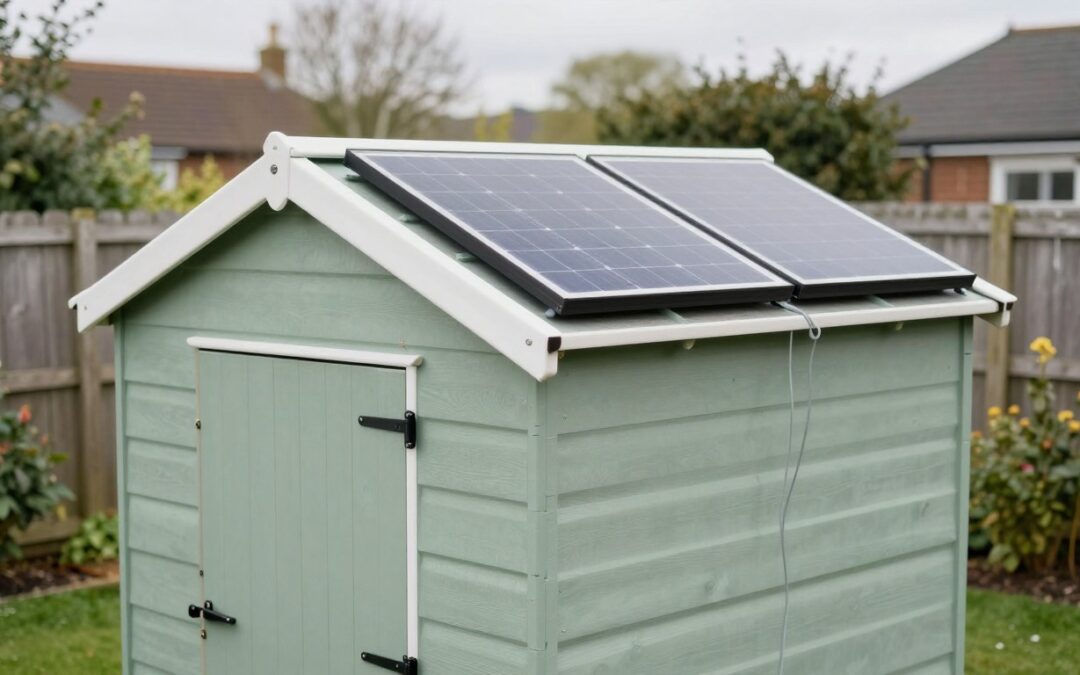
Most plug-in solar guides assume you have a balcony or a south-facing garden fence. But there is a setup that barely gets mentioned and that suits a huge number of UK homes: the shed, the garage, the workshop, the summerhouse. If you have a south-facing roof or wall on any outbuilding and a cable run back to the house, you might be sitting on the most convenient plug-in solar install available.
Here is everything you need to know.
Why outbuildings are actually ideal for plug-in solar
Shed and garage roofs have a few things going for them that balconies and garden fences often do not. They are typically clear of shading from the house itself. The roof pitch on most UK outbuildings sits between 15 and 35 degrees — not far off the optimal tilt range for UK solar. And because they are detached structures, there is usually good airflow around the inverter, which keeps temperatures down and prevents the thermal throttling that costs output on hot days.
A flat garage roof is the best case of all. Most are felt or EPDM, structurally sound, and sitting unused. A pair of 400W panels at 30 to 35 degrees on a south-facing flat roof will produce as much as any fence or balcony mount — and they are easier to tilt correctly because you are not constrained by a railing or wall angle.
What you actually need
For a plug-in system feeding back to your house, you need four things: panels, a microinverter, a way to mount the panels, and a cable connection back to the house consumer unit.
The panels and microinverter are the same kit you would use for any plug-in solar install. A two-panel 800W system with an EcoFlow STREAM microinverter or a Hoymiles HMS-800 costs between £400 and £600 depending on where you buy the panels. The microinverter mounts on or near the panels, outdoors, and is rated to handle UK weather without any issues.
The mounting is usually the easiest part with an outbuilding. On a pitched roof, standard panel mounting brackets clip directly to roof battens through the felt — same principle as rooftop solar, just smaller scale. On a flat roof, tilted ground-mount frames or ballast mounts sit on the surface without any penetrations at all. On a south-facing wall, fence-mount brackets work well. You do not need scaffolding; at shed height, a step ladder and a second pair of hands is all that is required for most installs.
The cable run back to the house is where people get confused, and it is the one part that does require a qualified electrician. The microinverter’s AC output needs to connect to a circuit on your house consumer unit — not to a socket in the shed. Under BS 7671 Amendment 4 (which came into force in April 2026 and made plug-in solar legal in the UK), the connection must be on a dedicated circuit with the correct RCD protection. See our Rules and Regulations page for the exact requirements.
The cable run: your main practical decision
How far is the outbuilding from the house? This is the question that determines whether the install is straightforward or complicated.
Up to about 20 metres, a standard SWA (steel wire armoured) cable buried at the correct depth or run in conduit does the job neatly. Most UK properties that have a garden shed with any kind of electricity already have an SWA run from the house — if yours does, the electrician is adding a circuit to an existing cable, which is a much simpler job than a new trench.
If there is no existing cable to the outbuilding, the cost of the trench and cable run is the biggest variable in your install budget. Budget £300 to £700 for a straightforward run, depending on distance and ground conditions. On top of the kit cost and the inverter connection work, a complete outbuilding install typically comes in at £800 to £1,200 all-in — more than a simple fence mount, but generating the same amount of electricity.
One shortcut worth knowing: if the outbuilding is close enough to the house, some installers run the AC cable externally in conduit along a fence line rather than burying it. It is less tidy but significantly cheaper and perfectly compliant if done correctly.
What about powering the shed itself?
A plug-in solar system feeds electricity into your house circuit, not into a local socket in the shed. That is an important distinction. If you want to power lights, tools or a phone charger in the shed, you need either a separate off-grid setup (a panel, a charge controller, a battery, and a 12V or inverter output), or the shed needs to be connected to the house ring main in the normal way, which is separate from the solar setup entirely.
Some people run both: a plug-in solar system feeding back to the house, and a small separate off-grid panel for a shed light and USB charging. They are completely independent systems and there is no conflict between them.
If your main goal is to power the shed itself rather than reduce your house electricity bill, an off-grid setup is probably the better choice. A 100W panel, a basic MPPT charge controller, and a 100Ah leisure battery costs around £150 to £200 and will run an LED light and a few phone charges indefinitely. Our Getting Started guide covers both on-grid and off-grid options.
Does it need planning permission?
For most UK properties, no. Solar panels on an outbuilding fall under permitted development in England, subject to the usual conditions: they should not protrude more than 200mm from the roof or wall surface, the installation should be removed when no longer needed, and it should not be on a listed building or in a designated area without specific consent. Scotland, Wales and Northern Ireland have similar provisions but with slight variations — check with your local planning authority if you are in any doubt.
The panels themselves are the permitted development part. The electrical connection back to the house is building regulations work under Part P, which is why a registered electrician is needed. The electrician handles the building regulations notification as part of the job.
How much will it generate?
The same as any 800W south-facing system in the UK: somewhere between 500 and 700 kWh per year in central England, somewhat more in the south, somewhat less in Scotland. The outbuilding itself does not change the generation figures — only the panel orientation, tilt angle and shading do.
At the Ofgem April 2026 price cap rate of 27.69p per kWh, 600 kWh of self-consumed generation is worth around £166 per year. The payback on a £1,000 installed system is roughly six years. After that it is free electricity for the remaining life of the panels, which on a quality product is 25 years plus.
Use our savings calculator with your postcode and orientation to get a figure specific to your setup.
Can I add battery storage?
Yes, and a garage or outbuilding is actually a better location for a battery than most places inside a house. Batteries prefer cool, stable temperatures — a well-ventilated garage maintains conditions closer to the ideal operating range than a utility room or airing cupboard. Systems like the EcoFlow STREAM Ultra X include built-in battery storage alongside the solar inputs, so the panels, inverter and storage are all in one unit. You can also add standalone battery storage separately and connect it to the same circuit.
A battery is particularly useful if your house is empty during the day. Without storage, any solar generation that is not immediately consumed by running appliances either goes to the grid (at a low export rate if you have SEG) or is wasted. A battery captures that daytime surplus and shifts it to the evening when the house is occupied and consumption is highest. See our EcoFlow STREAM FAQ for detail on the battery-integrated options.
The shed solar setup in summary
- An outbuilding roof or wall is often the best spot in the garden for a plug-in solar install.
- Flat garage roofs are particularly good — tilted frames can be set to the optimal angle.
- You need a cable run from the microinverter back to the house consumer unit, installed by a registered electrician.
- If there is no existing cable to the outbuilding, budget an extra £300 to £700 for the trench and run.
- Total installed cost for a complete 800W outbuilding system is typically £800 to £1,200.
- Generation and savings are the same as any other well-positioned 800W system: around £150 to £180 per year in central England.
- No planning permission required for most UK properties under permitted development.
- Want to power the shed itself? That is a separate off-grid question with a different and cheaper answer.
Further reading
- UK Rules and Regulations — what BS 7671, G98 and the BSI standard mean for your install
- Getting Started Guide — choosing panels, mounting options, and what to expect from an installer
- Best Plug-In Solar Kits UK 2026 — what to buy right now
- Savings Calculator — model your specific setup
- EcoFlow STREAM FAQ — battery storage options in detail
- Complete UK Guide — every plug-in solar question answered