Plug-In Solar for Narrowboats, Static Caravans and Holiday Lets: What You Need to Know
Plug-in solar was designed for the grid-connected home. But plenty of people want to know whether it works on a narrowboat, a static caravan, or a holiday let. The answer is: it depends on which version of plug-in solar you mean.
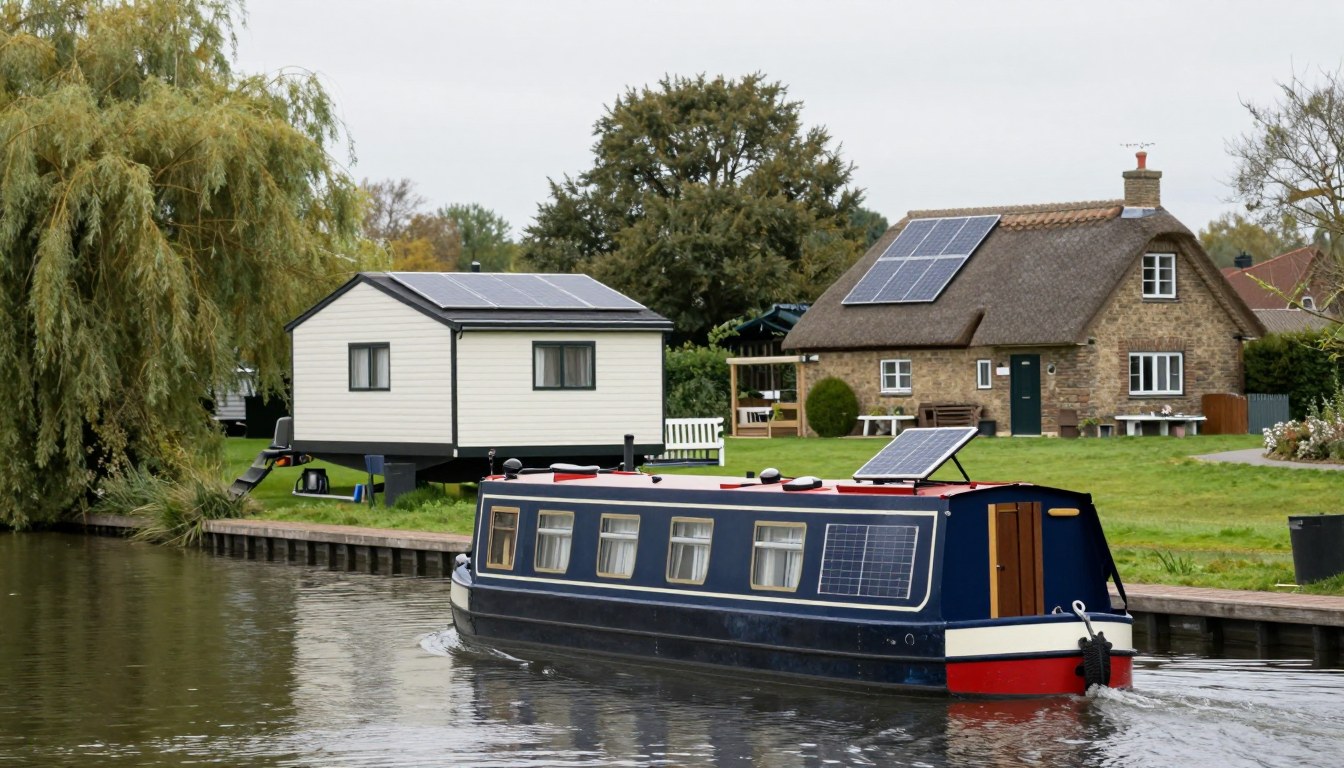
The phrase “plug-in solar” covers more ground than it should. When we use it on this site, we mean G98-certified grid-connected micro-inverter systems — the kind you plug into a UK 13A socket and that feeds electricity into your home’s circuit. That is a specific technology with specific requirements.
But a lot of people searching for plug-in solar are actually asking about solar power for alternative living situations: narrowboats, campervans, static caravans, holiday lets, remote cabins. Some of these work with G98 plug-in solar. Some of them need something entirely different.
Here is the clear guide.
Narrowboats: not plug-in solar, but solar works fine
Narrowboats typically run on 12V or 24V DC electrical systems, with a battery bank charged by the engine alternator, shore power, and optionally solar panels. The canal network has some 240V AC shore power connections at marinas, but life aboard is primarily 12V.
G98 plug-in solar requires a 230V AC grid connection. It will not work with a 12V or 24V DC system. The inverter in a G98 kit is specifically designed to synchronise with and feed into the AC grid — without a grid connection, it does not operate.
What works on a narrowboat is a standalone marine solar setup:
– Solar panels: The same physical panels used in G98 kits can be used for marine/off-grid applications
– MPPT charge controller: Sits between the panel and the battery bank, optimising the charge
– Battery bank: 12V or 24V lead-acid or lithium batteries
– Inverter (optional): A standalone inverter (not a G98 micro-inverter) to convert battery power to 230V AC for appliances
This is mature technology, widely used on narrowboats, motorhomes, and off-grid cabins. It is not regulated by G98 and does not require DNO notification because it is not connected to the public grid.
If you are on a narrowboat and want solar: look at 12V marine solar systems, not G98 plug-in kits.
Static caravans: probably yes, with conditions
Static caravans are a more interesting case. Many UK static caravans are permanently sited on holiday parks and connected to the park’s electrical supply via a 230V AC hookup. If your static caravan has a standard ring main or socket circuit connected to 230V AC, a G98 plug-in solar kit can work exactly as it would in a house.
The practical considerations:
Park permission. Many static caravan parks have rules about modifications to caravans and pitches. Before installing anything, check with your park operator. Some parks are welcoming; others have restrictions, particularly around anything attached to the caravan exterior.
G98 DNO notification. If you install a G98-certified kit in a static caravan on a park with a 230V connection, you still need to notify the DNO. The park’s electricity supply likely comes from a DNO-managed connection; the notification requirement applies.
Roof loading and wind. Static caravans are lighter structures than houses, and their roofs are not designed for the same loads as a tile or slate roof. Roof-mounted panels on a static caravan require careful assessment of structural loading and wind resistance. Ground-mounted or freestanding panels adjacent to the caravan are a lower-risk option.
Seasonality. Many UK static caravans are on parks that are closed in winter. If the caravan is only occupied April to October, your G98 plug-in solar generates only during those months. This affects the economics compared to a year-round home installation.
Holiday lets: yes, if you own the property
If you own a holiday let — a cottage, flat, or house that you rent out to guests — you can install a G98 plug-in solar kit in exactly the same way as any other residential property you own. The solar generates electricity that reduces the property’s electricity bill, and you as the owner pay less to the energy supplier.
The DNO notification applies. The installation should be by a competent person (or yourself, if confident with electrical work), following G98 standards.
One point of nuance: some holiday lets are on sites managed by park operators (lodges, log cabins), and the same park permission consideration as static caravans applies. If the property is entirely standalone — a cottage with its own meter and supply — no park permission is needed.
Guests using the property do not need to know or do anything differently. The solar simply generates when the sun shines; the meter runs slower; the bill is lower.
Airbnb and rental properties: if you are the guest
If you are a guest in someone else’s Airbnb or holiday let, you cannot install plug-in solar — even temporarily. The property’s G98 installation must be by the owner (or their agent), with proper DNO notification. A visitor cannot install a micro-inverter into someone else’s property.
What a guest can do is use a portable power station with solar input: an EcoFlow DELTA, Jackery, Bluetti, or similar device. These:
– Accept solar panel input (via appropriate cables)
– Store electricity in an internal battery
– Output 230V AC or USB power for your devices
This is completely off-grid — no connection to the property’s electrical circuit required, no permissions needed. You bring the power station and panel(s), set them up in the garden, and charge your devices from the stored power. The output is limited (typically 200W to 2kW depending on the unit), but for camping-style needs it is useful.
Campervans and motorhomes
The same off-grid logic applies to campervans and motorhomes as to narrowboats. A G98 kit requires a grid connection — campervans do not have one while travelling (though some campsites have hookup points).
The right solution for campervans is a 12V or 24V solar system with an MPPT charge controller and leisure battery, exactly as for narrowboats. Portable power stations are also popular for vanlifers who want an easy-to-use solution without installing fixed wiring.
Summary
| Situation | G98 plug-in solar | Standalone off-grid solar |
|---|---|---|
| House with 230V supply | ✓ Yes — standard installation | Not the right tool |
| Static caravan with 230V hookup | ✓ Probably, with park permission | Could work alongside |
| Holiday let (owner) | ✓ Yes — standard installation | Not the right tool |
| Narrowboat | ✗ No — wrong voltage system | ✓ Yes — 12V marine setup |
| Campervan | ✗ No — no grid connection | ✓ Yes — 12V van setup |
| Guest at Airbnb | ✗ No — not your property | ✓ Portable power station |
The technology that solves your problem depends on your situation. G98 plug-in solar is the right tool for grid-connected properties — for everything off-grid or mobile, you need a different approach, and that approach is well-established and equally accessible.