What Is a Micro-Inverter and Why Does Every Plug-In Solar Kit Have One?
Every plug-in solar kit contains a micro-inverter. Here’s what it does, why it matters, and what to look for when choosing one.
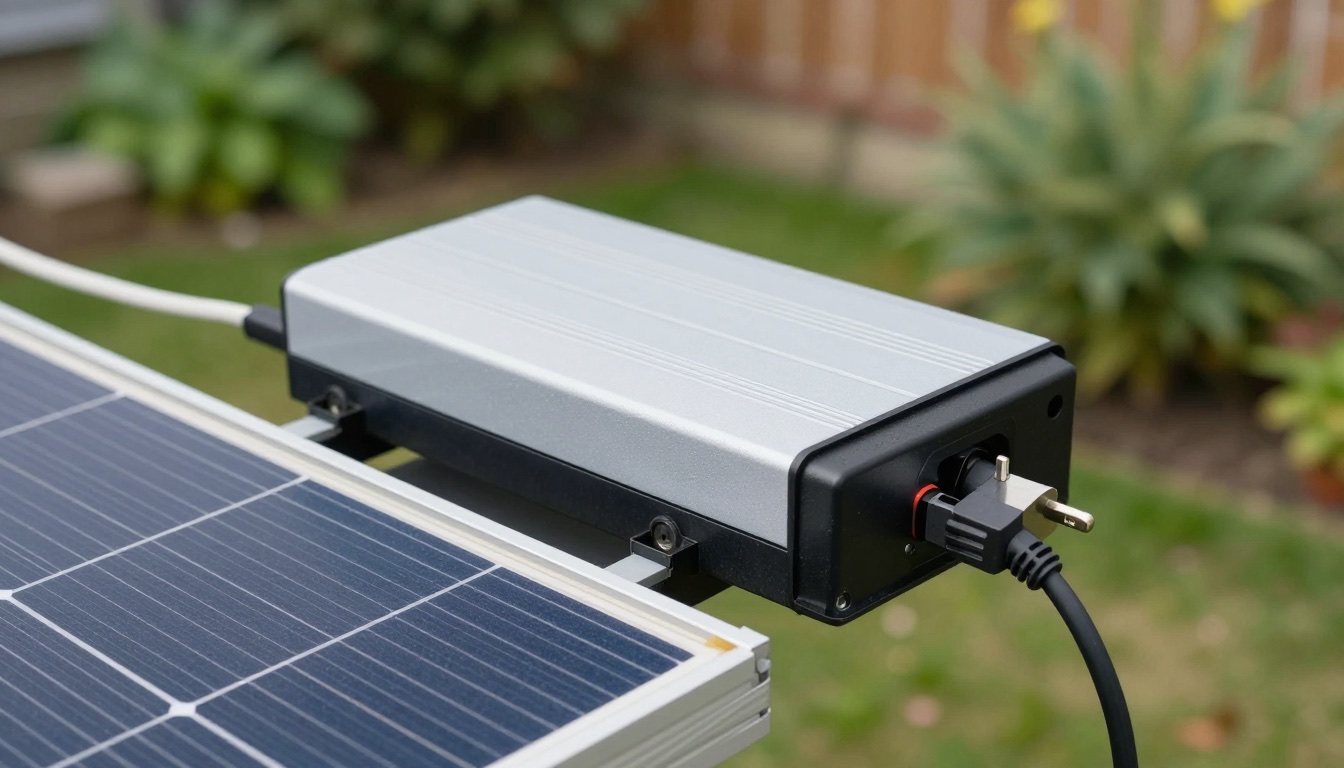
If you have ever looked at a plug-in solar kit — whether on the EcoFlow website, from Anker, or from any of the other brands now selling certified kits in the UK — you will have noticed that the kit always includes two main components: the panel, and something called a micro-inverter.
The micro-inverter is the smaller, less glamorous of the two. The panel is the thing that catches sunlight. The inverter is the thing that turns that sunlight into electricity you can actually use.
Understanding what it does and why it works the way it does makes you a better buyer and gives you a clearer picture of what you are actually installing in your home.
Why do you need an inverter at all?
Solar panels produce DC electricity — direct current at a variable voltage, depending on how much sunlight is hitting them. This is different from the AC electricity — alternating current at 230V — that your home is wired for and that everything in your house plugs into.
You cannot plug a solar panel directly into a socket. The voltages do not match, the current type is wrong, and there is no safety protection against backfeed to the grid. The inverter solves all three problems.
A micro-inverter takes the DC output from your panel, converts it to 230V AC at 50Hz (the UK standard), and outputs it through a cable with a standard 13-amp plug. When you plug that into a socket, the inverter’s AC output feeds into your home’s wiring and is immediately available to any appliances running in your house.
The inverter also monitors the grid, synchronises its output to match the grid frequency exactly, and includes protection systems that shut it down safely if the grid fails or if any fault condition is detected.
Micro-inverter vs string inverter: what is the difference?
Before micro-inverters, solar installations used string inverters. These are larger units — typically mounted in a garage or utility room — that handle multiple panels connected in a series chain (a string). The string inverter combines the output of all the panels and converts the total DC power to AC.
String inverters work well when all the panels are in identical conditions — same orientation, same tilt, same sunlight, no shade. In those conditions they are efficient and cost-effective.
The problem is partial shading. If one panel in a string is shaded — by a chimney, a tree, a neighbouring building — its reduced output limits the whole string. A string of ten panels where one is 50% shaded does not produce 95% of its maximum output. Depending on the configuration, it may produce significantly less.
Micro-inverters solve this by giving each panel its own dedicated inverter. If one panel is shaded, only that panel’s output is reduced. The other panels continue operating at their individual maximum. For a plug-in solar installation where panels may be on a garden fence, in partial shade from a neighbour’s extension, or facing different directions, micro-inverters offer genuinely better performance.
The other advantage of micro-inverters is modularity. Each panel is an independent unit. Adding a second panel does not require replacing or reconfiguring a central inverter — you just add another panel and another micro-inverter. This suits the incremental approach many plug-in solar users take: start with one panel, see how it goes, add a second in the spring.
MPPT: extracting the maximum from every panel
Every modern micro-inverter includes MPPT — Maximum Power Point Tracking.
A solar panel does not produce a fixed output. Its voltage-current relationship varies continuously as temperature and light intensity change. There is always a specific operating point at which the panel produces maximum power — the maximum power point — and it shifts throughout the day and with changing cloud cover.
An MPPT controller in the inverter continuously scans the panel’s operating characteristics and adjusts the load it presents to the panel to keep it operating at the maximum power point. The difference between an inverter with good MPPT and one with poor or no MPPT can be 5 to 20 percent of total generation — significant over a year.
For plug-in solar kits with two panels, look for a dual MPPT inverter. A dual MPPT unit tracks each panel independently, which is important if the two panels are at different orientations (east and west, for example) or experience different shading patterns. A single MPPT inverter with two panels tries to find a single compromise point, which underperforms when the panels are receiving different amounts of sun.
Anti-islanding: the most important safety feature
If you plug in a solar micro-inverter and then the grid goes down — a power cut — what happens?
Without anti-islanding protection, the inverter would keep generating. If electrical workers are repairing the line that caused your power cut, they could be working on what they believe to be a de-energised cable — but your inverter is feeding electricity into it. This is dangerous.
Anti-islanding protection detects the loss of grid voltage and frequency and immediately shuts the inverter down, within milliseconds. The inverter does not restart until the grid comes back and has been stable for a set period (typically 20 seconds for UK G98 requirements).
This is mandatory for all G98-compliant inverters and is one of the key things the type test process verifies. It is also why a plug-in solar system does not provide power during a power cut — the inverter shuts down when it loses its grid reference. If you want solar backup power during an outage, you need a battery system with specific islanding or off-grid capability, which is a different and more complex product category.
What to look for in a micro-inverter
When choosing a plug-in solar kit, the quality and specification of the micro-inverter matters as much as the panel specification. Here is what to check:
G98 type test registration — Essential for UK grid connection. The ENA publishes the Type Test Register, which lists compliant products. Confirm your inverter is on it.
Dual MPPT — Important if you are running two panels that may face different directions or experience different shading.
Monitoring connectivity — Most modern micro-inverters include Wi-Fi and connect to a monitoring app. Check that the monitoring platform is actively maintained and has UK-friendly data presentation (pounds, kWh, not watts-peak at a foreign timezone).
Warranty — A minimum 10-year warranty is standard from quality brands; 25-year warranties are offered by premium manufacturers. The inverter is the component most likely to fail in a solar installation, so warranty matters.
Brand longevity — Buy from a manufacturer that will exist to honour a warranty claim in 10 years. Enphase, Hoymiles, and the major brands (EcoFlow, Anker) are more likely to still be trading than a no-name unit from an unknown manufacturer.
What is inside a micro-inverter?
For the technically curious: a micro-inverter is essentially a DC-to-AC power conversion circuit with control electronics.
The core components are a DC-DC boost stage (which takes the variable panel voltage and raises it to a stable intermediate DC voltage), a DC-AC inverter stage (which converts the stabilised DC to sinusoidal AC at 230V 50Hz using switching transistors), and a control processor (which manages MPPT, grid synchronisation, protection systems, and monitoring communications).
The whole thing is encapsulated in a weatherproof housing, typically rated IP65 or better, and designed to be mounted outdoors in the UK climate — cold, wet, and occasionally very hot. Quality units use polycarbonate or aluminium enclosures and components rated for the full range of UK operating temperatures.
No moving parts. No consumables. A well-made micro-inverter is genuinely expected to last 25 years without maintenance, and early field evidence from the US market (where micro-inverters have been in use since the late 2000s) supports that expectation.