
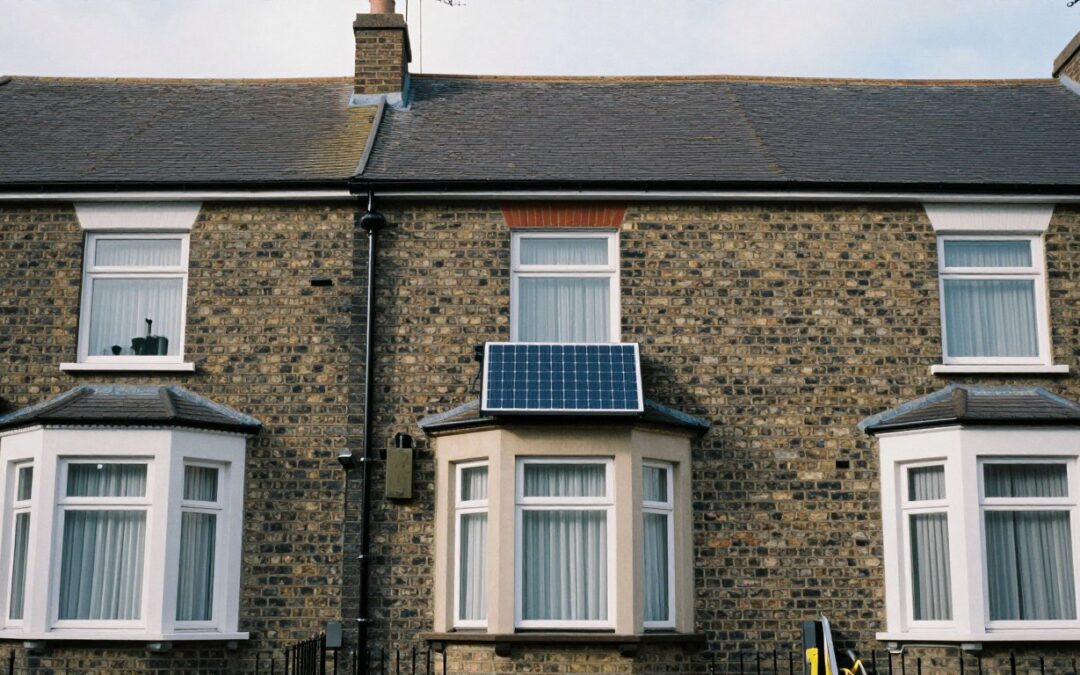
Terraced houses make up a large proportion of the UK housing stock, particularly in cities and older towns. They present a specific challenge for solar: the front of the house faces one direction and the back the other, and in a typical UK street layout one of those faces north and the other south. For conventional rooftop solar, which direction your roof faces largely determines whether it is worth doing. For plug-in solar, you have more options.
The typical terraced house layout
In most UK terraced streets, properties run roughly east-west, meaning the rear garden faces either north or south depending on which side of the street you are on. South-facing rear gardens are the optimal scenario. North-facing rear gardens are the challenging one. Front gardens are typically too small and too overlooked for practical panel placement, and many are now paved over for parking.
Before deciding on placement, check which direction your rear garden actually faces. A compass bearing is more reliable than a rough guess based on where the sun appears. A south-facing rear garden in a terraced house is actually an excellent position for a ground-mounted plug-in solar setup.
South-facing rear garden
This is the best-case scenario for a terraced house plug-in solar installation. A ground-mounted frame in a south-facing garden can be positioned at the optimal 35 to 40 degree tilt, giving maximum output. An 800W system in a south-facing terraced rear garden in central England generates around 600 to 700 kilowatt hours per year, saving £165 to £195 annually at current rates.
Practical considerations: the cable run from the garden to an indoor socket needs to be properly managed. An outdoor socket in the garden is the neatest solution. Fence-mounted panels on a south-facing fence are another option, though output is slightly lower than a tilted ground frame due to the vertical angle.
North-facing rear garden
If your rear garden faces north, plug-in solar in the garden is not a good investment. Output from a north-facing panel in the UK is too low to give a sensible financial return. However, you are not necessarily without options.
If your front elevation faces south, side-return panels, a south-facing shed at the end of the garden accessed via a side passage, or even a panel in the front garden propped against the house wall (with appropriate permissions if you rent) might be worth exploring. These are less conventional setups but not impossible.
Terraced house neighbourhoods and group installation
One of the practical suggestions from our installer article is worth revisiting specifically for terraced streets. If you and several neighbours in the same terrace all want plug-in solar installed, grouping the jobs makes a roofer or electrician much more likely to take the work on. A south-facing terrace where six houses all want the same two-panel setup in their rear gardens is a half-day’s work for a contractor, not six individual call-outs. The savings per household can be significant.
A note in the neighbourhood Facebook group or a knock on a few doors asking if anyone else is considering solar is often enough to find two or three interested households in the same street. If you go ahead with a group approach, our Getting Started guide covers what each household needs to do individually for G98 notification.