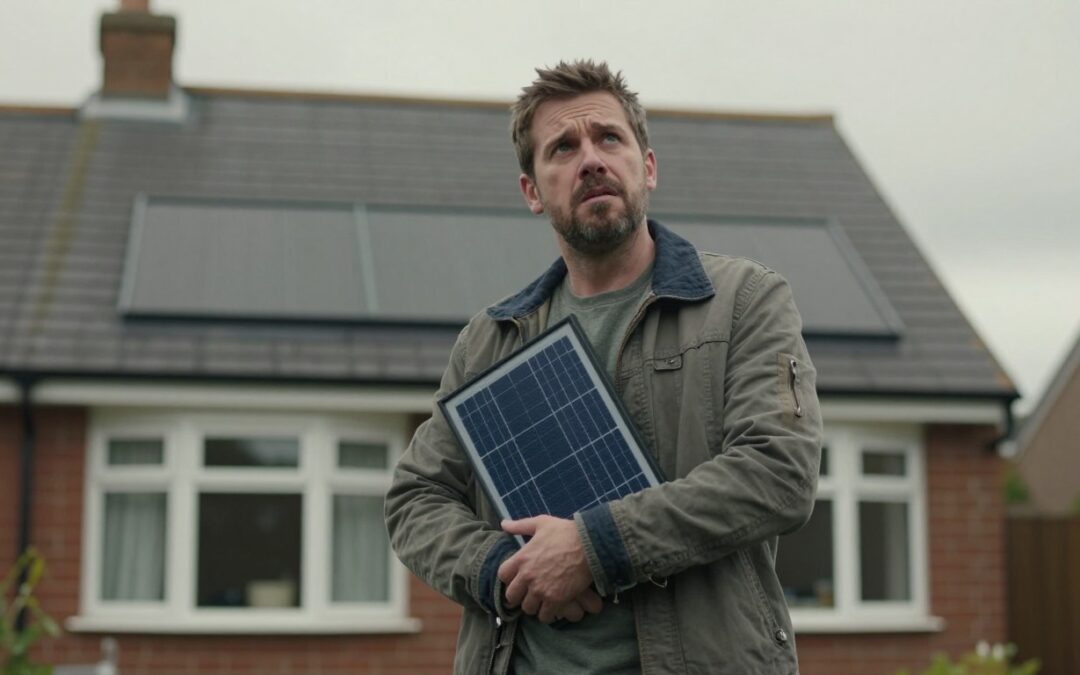
There is a frustrating gap in the UK plug-in solar experience that nobody talks about much. The government has legalised the systems. The regulations are updated. The products are available. And then you try to find someone to fit your panels and you run into a wall.
You are not imagining it. The installer problem is real, it is widespread, and it is one of the more significant barriers to the mainstream UK rollout that the headlines about Lidl and Amazon do not mention. Here is what is going on, and more usefully, how to get around it.
Why solar companies are not interested in your job
Most solar installation companies in the UK operate on a supply-and-install model. They source the panels, the inverter, the mounting hardware, the cables, and the monitoring equipment — and they fit all of it as a package. Their margin sits across the whole job, not just the labour. A full rooftop installation might be worth £6,000 to £10,000 in total revenue. A plug-in solar fitting job using kit you have already bought and paid for is worth, at most, a couple of hours of labour.
When you call a solar company and explain you have your own panels and just need someone to mount them and make the electrical connection, you are asking them to swap a potentially high-margin job for a low-margin one. Most will say they are too busy, not taking on new customers, or simply will not return the call. It is not personal. It is just commercial arithmetic.
As the founder of this site discovered firsthand when trying to get his own system installed, the dynamic can shift the moment a bigger job is mentioned — but if all you have is a couple of panels and your own inverter, you are a low priority for most established solar companies regardless of how politely you ask.
The supply chain problem is making it worse
Demand for solar installations in the UK hit record levels in early 2026. The government’s figures showed over 27,000 domestic installations completed in March 2026 alone. The installer workforce has not kept pace. Skills shortages persist across large parts of the country, particularly in northern England and Scotland, and most qualified installers with MCS certification are running full order books for months ahead.
The UK solar industry employs around 45,000 professionals as of 2026, but the pipeline of newly trained installers is still catching up with demand. What this means in practice is that even companies that might otherwise take on smaller jobs often do not have the capacity right now. The good jobs — full rooftop installations, battery systems, commercial work — fill their diaries first.
For plug-in solar buyers, this all adds up to a frustrating reality: the product has been legalised, but the infrastructure to support small DIY customers has not been built yet.
Try a local roofer instead
Here is something that most people do not realise: many solar installation companies do not actually employ their own roofers. They subcontract the roof mounting work to local roofing firms and keep the electrical work in-house. The roofer does the physical panel mounting — fixing the brackets, laying the rails, securing the panels — and the solar company’s electrician connects the wiring.
This means that for the physical part of a plug-in solar installation, a competent roofer is exactly who the solar companies use anyway. If you go directly to a local roofer for the panel mounting, you are cutting out the middleman and potentially saving yourself a significant amount of money. The National Careers Service confirms that qualified roofers can take solar PV training specifically to fit panels to buildings — they just need to work with an electrician for the connection.
The division of work is straightforward:
- The roofer handles the physical mounting — brackets, rails, panel positioning, weatherproofing around any fixings.
- A local registered electrician handles the electrical connection and the G98 notification to your DNO.
Splitting the job this way opens up a much wider pool of people willing to help. Roofers are used to taking on smaller jobs. A local electrician who understands the G98 process is far easier to find than a fully certified solar installation company with capacity in their diary.
When approaching roofers, be clear about what you need: a straightforward panel mounting job, no roof penetration required for a balcony or ground-mounted setup, or a standard bracket fix for a roof installation. Show them a photo of your intended position and the kit you have. Most competent roofers will be comfortable quoting for it.
The group job approach: how to make yourself worth their while
There is another angle worth considering, particularly if you are finding that even roofers are not enthusiastic about a single small job.
Think about your immediate circle — friends, family, neighbours, people in your street. The interest in plug-in solar is widespread right now, and there is a reasonable chance that several people within walking distance of you are thinking about the same thing. If you can put together a small group of three, four or five households all wanting plug-in panels fitted, you have a very different conversation with a roofer.
Instead of asking someone to make a trip across town for two panels on one house, you are offering half a day’s work fitting panels at several addresses in the same area. The economics change entirely. The roofer makes better use of their time, you all get a better rate per job, and the electrician can do all the G98 connections in a single outing.
This approach works particularly well in terraced streets or areas with similar housing where the job specification is likely to be consistent across each property. A south-facing terrace where six neighbours each want two panels on their back garden fence or rear wall is a genuinely attractive proposition for a local roofer.
Getting the group together does not need to be complicated. A message in a local Facebook group, a note through a few letterboxes, or a conversation with a few interested neighbours is often enough to identify who else is thinking about it. The BSI certification expected in July 2026 will bring more people to the point of buying, so if you are planning ahead, now is a good time to identify who around you might be interested.
What to ask when you contact a roofer
Not every roofer will be familiar with solar panel mounting. A few questions worth asking upfront:
Have you fitted solar panels before, or are you willing to? Many roofers have fitted panels as subcontractors for solar companies and know exactly what is involved. Others may not have but will be confident with the structural elements of the job. What you want to avoid is someone who has never thought about it agreeing to a job and then improvising.
Are you happy to work alongside a separate electrician for the connection? Some roofers are used to this arrangement; others prefer a clean single-contractor job. Making clear from the start that the electrical element is handled separately avoids confusion.
Can you provide a written quote covering the mounting work only? This protects you and gives you something to compare. A straightforward ground-mounted frame installation or balcony railing mount should be a modest job — a few hundred pounds at most for a competent roofer.
Finding a registered electrician for the connection
Once the panels are mounted, the electrical connection is the part that currently requires a registered electrician under BS 7671 Amendment 4. The easiest way to find a qualified person is through the Electrical Safety First register or the NICEIC contractor search. When you contact them, ask specifically whether they are familiar with G98 notifications and microinverter connections. Most registered electricians will be comfortable with this, but it is worth confirming rather than assuming.
This requirement changes once the BSI product standard is published around July 2026. From that point, certified plug-in solar kits can be connected by plugging into a standard socket without an electrician. If your timeline is flexible and your panels are going to a balcony or garden rather than a roof, waiting for certified kits may mean you can skip the electrician step entirely. Our regulations page has the full detail on where the rules currently stand and what changes in July.
The bigger picture
The installation friction that plug-in solar buyers are hitting right now is temporary. As the BSI standard arrives, as certified self-install kits reach Lidl and Amazon shelves, and as the installer workforce grows to meet demand, the process will get easier. Germany went through the same teething phase after legalising balcony solar in 2023, and the market there is now genuinely straightforward for buyers.
For now, the most practical path is to go directly to local tradespeople — a roofer for the physical work and a registered electrician for the connection — rather than through solar installation companies whose business model does not suit smaller DIY customers. Pool the job with neighbours if you can. And keep an eye on the July BSI certification date, after which the whole process becomes considerably simpler.
If you are still in the research phase, the Getting Started guide covers the full process from choosing a kit to first generation, and the Best Kits of 2026 page covers what is worth buying right now.