Can Council House Tenants Install Plug-In Solar? Your Rights in Social Housing
If you rent from a council or housing association, your rights around plug-in solar are different from private renters. Here’s the current position and how to approach it.
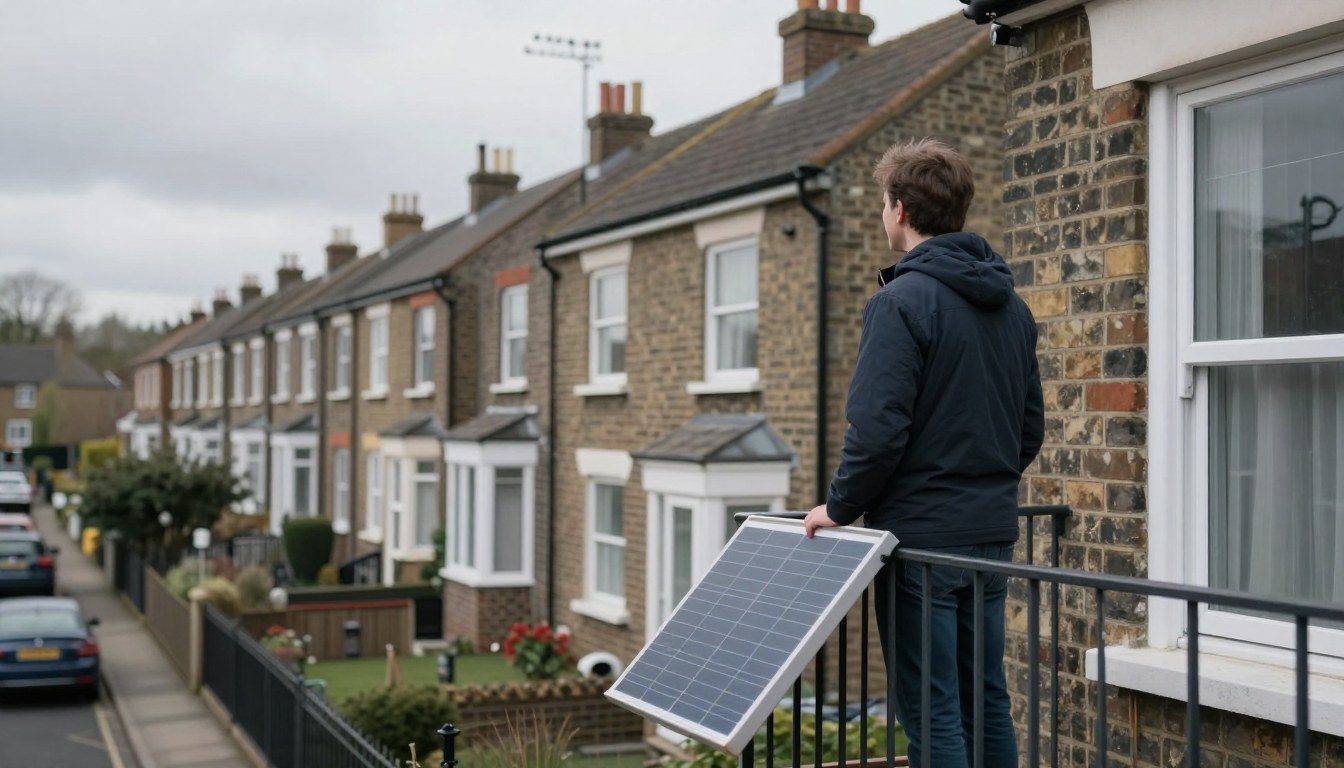
The plug-in solar revolution has been driven largely by homeowners. People who own their properties have the easiest path: they can install what they like without asking anyone’s permission (within planning rules), and they benefit directly from the electricity savings.
Renters have a harder time. They need landlord consent, which is not always easy to get — though the law has improved for private tenants in recent years.
But there is a third group that is often overlooked: social housing tenants. People who rent from a local council or a housing association, often on long-term secure tenancies, in properties they think of as home — sometimes for decades.
The situation for social housing tenants is distinct from both homeowners and private renters. Here is what you need to know.
Your tenancy agreement is the starting point
Whether you rent from a council or a housing association, your tenancy agreement sets out what you can and cannot do to the property. For most secure council tenancies, this will include a clause about alterations and improvements — typically requiring written consent from the council before making any changes to the structure or exterior of the property.
The same applies to housing association tenancies, which are typically assured tenancies under the Housing Act 1988.
“Exterior” is the key word for plug-in solar. A panel on a garden fence is different from one attached to the wall of the house, which is different from one on the roof. The more the installation involves the building’s structure, the more clearly it falls under the alterations clause.
The good news is that most tenancy agreements that require consent for alterations also specify that consent cannot be unreasonably withheld. This gives you leverage. A blanket “no” to a solar panel that poses no structural risk, uses no new wiring, and can be removed cleanly is harder for a social landlord to justify than a reasonable refusal with specific grounds.
The social housing context: different from private renting
Social housing landlords — councils and housing associations — are subject to obligations that private landlords are not.
Climate commitments. Many councils have declared climate emergencies and committed to net-zero targets. These commitments sit awkwardly alongside a blanket refusal to allow tenants to install solar panels. Councils that refuse tenant solar while championing their own sustainability credentials face an obvious inconsistency.
Decent Homes Standard. The Decent Homes Standard sets a minimum standard for social housing, including energy efficiency requirements. While it does not specifically require solar panels, the drive toward higher EPC ratings in social housing is pushing councils and housing associations toward energy improvements — including solar.
Social purpose. Social housing exists to provide affordable, secure homes. Rising energy costs have hit social housing tenants particularly hard. Plug-in solar that reduces a tenant’s electricity bill serves the social purpose of social housing.
None of this automatically means your council will say yes. But it gives you language for the conversation.
How to approach your council or housing association
The most effective approach is a written request that makes the case clearly and addresses likely objections.
State what you want to install. One 400W panel on a freestanding garden mount, connecting to a standard 13-amp socket inside the house. No drilling. No structural modifications. Can be removed completely in 30 minutes if needed.
State the benefit. Expected generation of 350 to 400 kWh per year, saving you approximately £87 to £100 per year on your electricity bill.
Address safety. G98-certified kits have built-in protection including anti-islanding (the inverter shuts down during a power cut). The installation connects via a standard 13-amp socket — no different from plugging in an appliance.
Address structural concerns. A freestanding mount on legs in the garden exerts no load on the building whatsoever. If the concern is about a wall-mounted bracket, offer the freestanding alternative as a compromise.
Reference the council’s own commitments. If your council has a climate emergency declaration or net-zero commitment, you can reasonably reference it: “I understand the council has a net-zero target, and this small measure supports that by reducing my household’s grid electricity use.”
Ask for a written policy. If consent is refused, ask for the specific policy or reason for refusal in writing. This matters if you want to challenge the decision.
The council retrofit solar programmes
Before applying for individual consent, it is worth asking whether your council or housing association has its own solar programme.
Many social landlords are running large-scale retrofit programmes to install solar panels on the roofs of their housing stock. These programmes are funded through government schemes including the Social Housing Decarbonisation Fund and the Warm Homes Plan. If your property is included in such a programme, you could have panels installed on your roof at no cost to you — generating electricity that reduces your bills — without needing to navigate the permission process for a private installation.
Ask your council’s housing team or housing association directly: “Does the council/association have a solar panel installation programme for social housing? Am I eligible?”
If the answer is no, this is also worth knowing — it means your individual request is not competing with a pending scheme that would address the same need.
Housing association properties: variable policies
Housing associations are independent organisations, not part of central or local government. Their policies on tenant solar vary enormously — some are explicit supporters, others have not considered it at all.
The larger housing associations (Clarion, L&Q, Hyde, Riverside, Places for People) have sustainability teams and are generally more likely to have thought about solar policy than smaller local associations. Some have formal “green homes” frameworks that specifically address tenant solar.
If your housing association does not have a policy, your request may land on the desk of someone who has never considered the question. In that case, the written request approach above — making the case clearly and addressing obvious concerns — is even more important, because you may be shaping the policy as well as making your individual request.
The Renters’ Rights Act and social housing
The Renters’ Rights Act 2025 significantly improved the position of private tenants seeking to install solar panels, introducing a presumption in favour of consent for low-risk modifications including plug-in solar. However, this Act applies to private assured tenancies — most housing association tenancies and all council secure tenancies operate under different statutory regimes and are not covered in the same way.
The government has indicated an intention to extend similar protections to social housing tenants, but this has not yet happened as of late 2026. The position for social housing tenants remains a matter of the tenancy agreement and the landlord’s policy rather than a statutory right.
Campaigners including Shelter and the Good Law Project have flagged the inconsistency between private and social tenant rights on this issue. It is an area to watch.
What to do if you are refused
If your request is refused and you believe the refusal is unreasonable:
- Ask for the refusal in writing with specific reasons.
- Write back addressing those specific reasons and offering modifications to your proposal.
- Consider escalating to the council’s housing complaints process or your housing association’s formal complaints procedure.
- If you are a council tenant, your councillor (local authority elected member) can sometimes help move things along — they have leverage with housing officers that tenants do not.
- As a last resort, the Housing Ombudsman investigates complaints about social landlords and has the power to require changes to policy if a landlord’s approach is found to be unreasonable.
This is a developing area. If you are a social housing tenant who has successfully navigated this process — or been refused — your experience is useful to others. Get in touch via the contact page and I will share what I learn.