
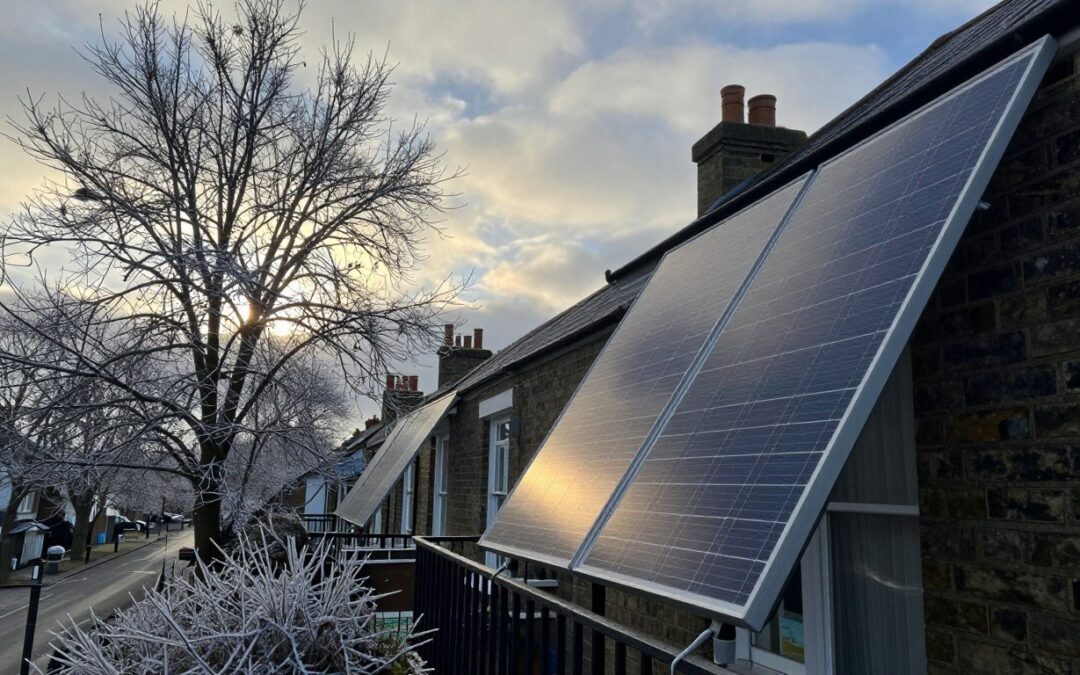
The clocks went back last weekend. The sun is setting before five o’clock. And if you have plug-in solar panels on your house, you are probably watching your generation numbers fall off a cliff compared to what they were doing in July.
That is entirely normal. It is also not the full story.
Winter in the UK is genuinely hard for solar — there is no point pretending otherwise. But hard does not mean zero, and there is real value to be extracted from the generation window that does exist, as long as you approach it the right way. Here is what I know, and what I am planning for when my own panels come back out of storage in the spring.
What winter actually does to your output
In June, a well-positioned 800W plug-in setup in central England can generate 4 to 5 kWh on a clear day — enough to cover a meaningful chunk of a typical household’s daytime electricity use. In December, the same setup on the same roof will produce somewhere between 0.5 and 1 kWh on most days. On a dark, overcast day in January it might struggle to reach 0.3 kWh.
The reasons are straightforward. The days are short — sunrise around 8am, sunset before 4pm in December, giving you maybe six hours of daylight, of which only three or four are truly useful for generation. The sun sits low in the sky, never getting above about 15 to 17 degrees above the horizon at noon even in the south of England. And the UK’s cloud cover is worse in winter than in summer, though not dramatically so — diffuse light from an overcast sky still produces real power, just a fraction of what direct sun delivers.
None of this means you should give up on your panels. It means you need to be deliberate about getting value from the generation that does happen.
Tilt your panels steeper
If your mount is adjustable, this is the single most effective thing you can do right now. In summer I wrote about dropping the tilt angle to catch the high midday sun. Winter is the opposite.
The sun in winter sits low on the horizon all day. A panel tilted at 30 or 35 degrees — which works well in summer — is presenting its face at the wrong angle to the low winter sun. Steepen it. A good rule of thumb is to take your latitude and add 15 degrees. For central England at around 52 degrees latitude, that means a winter tilt of roughly 67 degrees. For Scotland at 57 degrees, you are looking at 72 degrees or more.
A steep tilt also helps with two other winter problems. Rain and dew run off the panel more easily, so it self-cleans better. And a panel standing close to vertical sheds snow rather than holding it, which matters if you are in the north or at elevation.
Direction matters more in winter than in summer
In summer, a panel that faces slightly east or slightly west of true south loses relatively little, because the sun is in the sky for so many hours that it sweeps across a wide arc. In winter, the sun rises in the south-east, stays low, and sets in the south-west. The generation window is narrow and it is centred tightly on due south.
If your panels are on an east-facing fence or a west-facing wall, your winter output will be noticeably lower than a south-facing panel of the same spec. There is not much you can do about fixed installations, but if you have any flexibility on where your panels sit, point them as close to due south as possible before the solstice arrives.
Time your loads to match the generation window
In summer you can afford to be a bit casual about when you run the washing machine, because you are generating from 6am to 8pm on a clear day. In winter you do not have that luxury. The useful generation window is roughly 9am to 3pm, with the best output concentrated between 10am and 2pm.
This means the dishwasher, the washing machine, the tumble dryer if you have one, the EV charger — anything with a meaningful draw — should be timed to run in that midday window whenever possible. Most modern appliances have a delay timer built in. Use it. A washing machine set to start at 10am on a clear day will consume a meaningful fraction of its electricity directly from your panels rather than from the grid.
Smart plugs with energy monitoring are useful here. A plug on your solar circuit that lets you see real-time generation from your phone means you can make informed decisions about when to switch things on. The EcoFlow STREAM app does this natively; if you are using a third-party inverter, a Shelly or Tapo plug on the circuit gives you the same information.
Keep your panels clean
This matters year-round, but it matters more in winter. Autumn leaves, moss, algae, lichen and road grime all accumulate on the panel surface, and at the low sun angles you are working with in winter, even a small patch of shadow across a cell can disproportionately cut the output of the whole panel.
Most microinverters and plug-in solar inverters use bypass diodes to reduce the impact of shading, but they do not eliminate it. A panel that is 10 percent covered by grime is losing more than 10 percent of its potential output.
A soft damp cloth every few weeks through autumn and winter is all it takes. Do not use detergent — plain water is fine. If your panels are on a roof and you cannot safely reach them, a long-handled squeegee designed for solar panels will do the job from the ground.
Hot water is winter solar’s best friend
If you have an immersion heater in a hot water cylinder, winter solar and a timed immersion are an excellent combination. Heating water is a forgiving job for an intermittent power source — it does not matter if the power comes in a short burst at midday rather than steadily through the day. The cylinder stores the heat whether it arrived from the grid, the boiler, or your panels.
Set your immersion timer to run between 11am and 1pm. On days when your panels are generating well, a meaningful chunk of that heat comes for free. On cloudy days the immersion tops up on grid power as normal. Either way your boiler or heat pump does less work, and your standing hot water cylinder is not wasting electricity reheating water that cooled down overnight.
If you want to be more sophisticated about it, a solar diverter like the iBoost or MyEnergi Eddi can automatically route excess solar generation to your immersion — but for a plug-in solar setup generating modest winter power, a simple timer set to the midday window achieves most of the same result without the added hardware cost.
Should you leave them up or put them into storage?
My panels went into storage a couple of weeks ago. The reason was partly practical — I still have not found anyone locally to do the fence installation I want, so they were leaning against the garden fence at a suboptimal angle and getting progressively shadier as the neighbour’s trees dropped their leaves. It made sense to bring them in and come back to it properly in the spring.
But that is my situation. Yours might be different.
If your panels are on a good south-facing adjustable mount and you can clean them without too much difficulty, leaving them up through winter is worth doing. You will not generate a lot, but you will generate something, and those kilowatt-hours still count toward your payback. At current prices, even 0.5 kWh a day through the winter months adds up to 60 to 80 kWh and roughly £20 to £25 by the time the clocks go forward.
If they are awkwardly positioned, heavily shaded in winter, impossible to clean, or just creating anxiety you can do without, putting them away is a perfectly sensible call. Storage is not failure. It is just energy management.
What to watch through winter
The bigger picture for plug-in solar in the UK is moving fast even if your panels are in the loft. The ENA G98 Type Test Register now has certified kits on it, the Octopus Energy kit launched in August, and the retail picture is gradually building. By the time you reinstall in spring — whether that is February or March or April — there should be more certified hardware to choose from, potentially better installer coverage, and a clearer sense of how the Lidl and Iceland retail launches are going to land.
I will be covering all of that through the winter as it develops. If you are in the planning phase and want to know what to buy when the time comes, the best kits guide is kept up to date, and the savings calculator will give you an idea of what your setup could earn back over a full year.
And if you are in Lincolnshire and you fit solar panels for a living, you already know where to find me.