I have been running plug-in solar on my home in Stamford since earlier this year. The EcoFlow STREAM setup is a very much DIY installation on the south fence, feeding house circuits, working alongside Octopus Intelligent to keep the bills down.
What I cannot do, what I have been trying to do for months and still have not managed, is to find someone local who can help me take the system further. Specifically: mounting panels on the roof of my office, drilling a clean cable entry through an external wall, and generally doing the physical installation work that needs competent hands and the right tools rather than just knowledge.
This is not a niche problem. As I covered in the launch day article, the shortage of people who know plug-in solar and can help with installation is one of the biggest practical barriers in the UK right now. The technology is straightforward. The legal framework arrived today. The fitters have not caught up.
This article is partly a practical guide to what skills you actually need for a plug-in solar installation in Lincolnshire, so you know who to look for and what to ask. And it is partly an open call. If you are a tradesperson in Lincolnshire who can do this work, or who wants to learn it, there is a growing number of homeowners across the county who need exactly what you offer. Read on.
What plug-in solar installation actually involves
The “plug-in” label gives a misleading impression of simplicity. For a fence or balcony installation with no roof work, the description is largely accurate. Panels mount on the fence, DC cables run to the microinverter, the AC lead goes to the socket. A competent DIYer with basic tools can handle it.
But for anything beyond the simplest ground or fence installation, the work requires real skills and the right equipment. Here is what a typical Lincolnshire job actually involves.
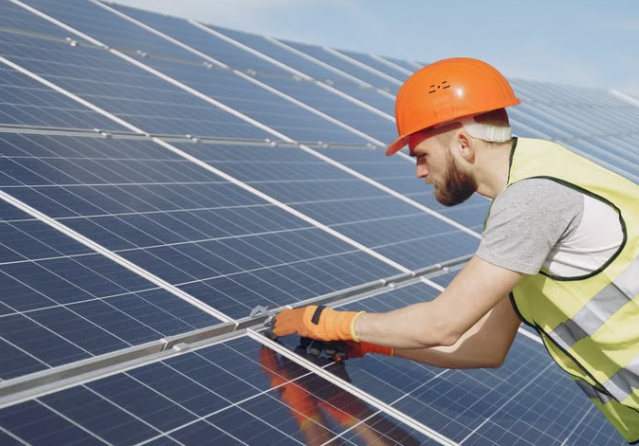
Fitting panels to a tiled roof means working at height with appropriate safety equipment, selecting the right mounting brackets for the tile profile, and drilling into rafters accurately without causing damage. Concrete interlocking tiles, clay pantiles, and flat profiles all need different bracket types. An incorrectly fitted roof bracket that allows water ingress will cost far more to fix than the installation itself. This is scaffolding or harness work, not a job for a ladder and optimism.
South-facing walls are common for terrace houses in Stamford, Grantham, and Lincoln where the rear of the property faces south, and they are an excellent location for panels that avoids the roof access problem entirely. Wall mounting requires appropriate fixings for the construction. Solid brick, cavity brick, and stone all behave differently. For a stone-built property in Stamford specifically, the fixings need to be appropriate for the material and the brackets need to carry the panel weight and wind load correctly.
The DC cables that run from panels to microinverter use MC4 connectors, weatherproof push-lock connectors that require a dedicated MC4 crimping tool to make properly. Incorrectly crimped MC4 connections are a leading cause of plug-in solar faults and, in the worst case, fire risk from resistance heating at a poor connection. The cables need to be UV-resistant, rated for outdoor use, and run in a way that protects them from physical damage. As covered in our DC cable length article, shorter is always better. A skilled installer routes cables cleanly and efficiently, not just adequately.
Running the AC cable from an outdoor-mounted inverter into the house requires drilling through the external wall cleanly, installing an appropriate cable gland or weatherproof entry, and making good both sides. A 230-year-old stone wall in central Stamford needs a different approach from a 1980s cavity brick house in Bourne or a timber-framed property in a Grantham new-build. Making good afterwards, matching render, repointing stone, is a separate skill again.
For battery-integrated systems like the EcoFlow STREAM Pro, Ultra, or Ultra X, the connection to the house electrical system must be hardwired by a CPS-registered electrician. That means fitting a dedicated circuit at the consumer unit, installing appropriate overcurrent protection, submitting the G98 notification to the DNO (Western Power Distribution covers most of Lincolnshire), and signing off the installation. For the basic socket-connection route with no battery, consumer unit work is not required. But if you want battery storage, you need an electrician who is comfortable with microinverter installations and actually knows what G98 is.
Once the physical work is done, the system needs commissioning. Connecting the inverter to Wi-Fi, binding it to the monitoring app, checking generation figures are appearing correctly, and walking the homeowner through what the app shows. Most general tradespeople have never done this. It is not difficult, but it needs someone who has at least read about it beforehand.
The skills combination you are actually looking for
No single trade covers everything. The ideal installer is a combination of someone with working at height competence — PASMA or IPAF for access equipment, or harness training for roof work — and electrical competence, meaning CPS registration for consumer unit work or at minimum a solid understanding of DC circuits, MC4 connections, and the G98 notification process. Add building trades skills for drilling, making good, and cable management, and basic tech literacy for app commissioning, and you have a complete installer. That person is rare.
The most natural fit from existing trades in Lincolnshire is probably a domestic electrician who has done some solar work and is willing to learn the plug-in solar specifics, or a solar installer prepared to quote for smaller-scale plug-in work rather than only full rooftop MCS installations. What is almost nonexistent right now is someone who has put all of it together specifically for the plug-in solar product category.
Where I am and what I need — and where you come in
I am in Stamford, PE9, right on the Lincolnshire/Rutland border close to the A1. The county reaches north to Lincoln, east through Boston to the Lincolnshire coast, south through Grantham, Bourne, and Spalding, and west through Sleaford. Market Rasen, Louth, Skegness, Horncastle. Lincolnshire is geographically large and the installer gap is felt across all of it, not just the main population centres.
What I need personally is what a growing number of Lincolnshire homeowners are going to need over the coming months. Someone who can assess the mounting options, fit the panels correctly, run the DC cables cleanly, make the wall penetration weatherproof, and leave the job looking like a proper installation rather than something bodged together on a Sunday afternoon.
I have not found that person yet. If you are reading this as a tradesperson in Lincolnshire, an electrician in Grantham, a builder in Boston, a handyperson in Lincoln, a roofer covering the Stamford and Bourne areas, this is a new market with real demand and no established players yet. The homeowners who bought a kit from Argos this week are going to need help. The homeowners who bought an EcoFlow STREAM Ultra X and need a CPS electrician for the hardwired connection are going to need help. The people in Spalding and Sleaford and Skegness who are working out where to put their panels are going to need help.
Solar Plugin UK is the resource they will use to find that help. If you want to be the name they find, get in touch. We are building a directory of Lincolnshire trades who can help with plug-in solar installation, and we would rather recommend someone we have spoken to than send readers to a generic directory listing.
For Lincolnshire homeowners looking for help right now
If you are in Lincoln, Grantham, Stamford, Boston, Spalding, Bourne, Sleaford, Louth, Market Rasen, Horncastle, Skegness, or anywhere else in the county, here is the honest picture today.
A simple fence or balcony installation on the socket-connection route is within reach of a competent DIYer. Our outdoor mounting guide covers what is involved. If you are comfortable drilling into timber or brick, working with cable clips and trunking, and following instructions carefully, you can handle it without a professional.
Roof mounting is different. Do not work at height without appropriate equipment and experience. This is the piece that genuinely needs a professional, and it is worth waiting for the right person rather than compromising on safety to get it done faster.
For battery-integrated systems needing a CPS electrician, the G98 guide explains what the electrician needs to do. When you find one, sharing that article with them will save time if they are new to plug-in solar specifically.
And if you find a good installer in Lincolnshire who is doing this work well, tell us. Leave a comment with their area and a brief note on what they did for you. Word of mouth is how this market builds, and a recommendation from a real customer in the comments is more useful to the next reader than anything we can write.