
On 22 June 2026, Octopus Energy CEO Greg Jackson walked on stage at the company’s Energy Tech Summit in London holding a small grey cube. That cube is the Nook — Octopus’s first own-brand home battery, announced as a direct response to the 10 million UK households that rent their homes and have until now had no realistic path to battery storage.
It is not on sale yet. It will not be until 2027. But it is already one of the most talked-about products in the UK home energy space, and the questions are coming thick and fast. Here is every answer we have, every gap we are honest about, and a straight comparison with what is available right now.
You can check out the Nook on their website – https://octopus.energy/nook/
The basics
What is the Octopus Nook?
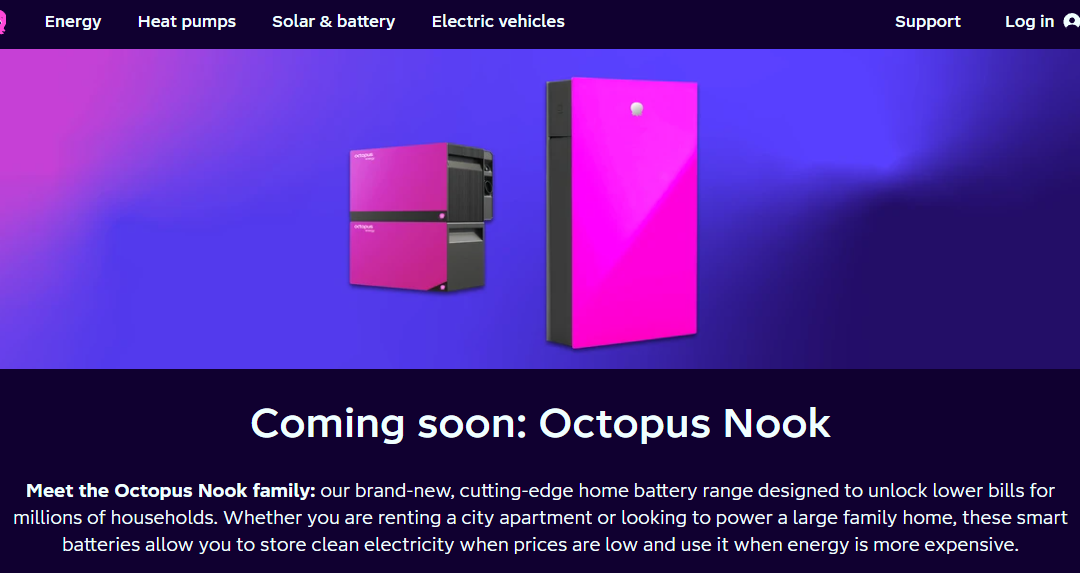
The Nook is Octopus Energy’s own-brand home battery range, announced at the Octopus Energy Tech Summit on 22 June 2026. It comes in two very different products: the Nook Cube, a plug-in battery aimed at renters and flat-dwellers, and the Nook Colossus, a wall-mounted system for homeowners. Both integrate with Octopus’s Kraken smart tariff platform to automatically optimise when they charge and discharge based on electricity prices. Both carry a 12-year warranty. Neither is on sale yet — launch is planned for 2027.
What is the Nook Cube specifically?
The Nook Cube is a 2kWh battery roughly the size of a shoebox. It plugs directly into a standard 13A household socket. No drilling, no fixed installation, no electrician, no landlord permission for structural work. Up to five Cubes can be linked through the Octopus app to give a combined 10.5kWh of storage. It is the only announced plug-in battery product from a major UK energy supplier and is specifically designed for the millions of UK renters who have been locked out of battery storage until now.
What is the Nook Colossus?
The Colossus is a wall-mounted home battery for owner-occupiers. The base unit is 5kWh, stackable to 30kWh for larger homes. It will be installed by Octopus engineers rather than being a DIY product. Greg Jackson claimed it will be “about a third cheaper than the best-known battery brands” — which, against a Tesla Powerwall 3, would price a 10kWh Colossus at roughly £5,000 to £6,000 installed. Octopus has not confirmed pricing. One discrepancy to flag: the official press release states 5kWh as the base unit, but the ETS 2026 live blog referenced 10kWh. Octopus has not resolved this publicly — treat the 5kWh figure as more reliable until confirmed otherwise.
When does it go on sale?
2027. No specific date has been announced. The launch covers the UK, Germany, France, Italy and Spain simultaneously. Octopus has opened a waiting list — if you are interested, registering now is worth doing as demand at launch is likely to be significant given the coverage the announcement received.
How much does it cost?
Octopus has not announced pricing for either product. Based on the “two or three years” payback claim Greg Jackson made on stage, independent analysts have worked backwards to estimate the Cube would need to retail at around £400 to £700 for that figure to hold, assuming typical savings on a time-of-use tariff. For the Colossus, the “third cheaper than Tesla” benchmark suggests roughly £4,500 to £6,000 for a 10kWh installed system. Both of these are estimates from the available evidence, not confirmed numbers.
How it works
How does the Nook Cube charge?
It charges from a standard 13A socket, drawing power from the grid when electricity prices are low. On tariffs like Octopus Go or Intelligent, that means overnight at rates as low as 7p per kWh. The Kraken platform automates this based on your tariff rates and usage patterns — you do not need to manually set charging times once the initial setup is done.
How does the Nook Cube discharge?
This is the one area where Octopus has been less than precise. Charging from a socket is legally and technically unambiguous — any battery does this as a load. How the Cube feeds power back into the home is a different question. Octopus has not confirmed the technical method publicly as of August 2026. A battery that discharges back into a socket to feed the home’s circuits is a different electrical proposition from one that powers appliances directly through its own outlets. Given the plug-in solar regulations and the careful engineering frameworks around SI 2026/848, this is a detail that matters. We will update this article as soon as Octopus confirms the discharge mechanism.
Does the Nook Cube work without an Octopus tariff?
Octopus has not confirmed this either way, but the integration with Kraken — Octopus’s optimisation platform — is central to the product proposition. The strong implication is that you will need to be an Octopus electricity customer to use the full intelligence features. Whether a Cube can function as a basic manual battery on another supplier’s tariff has not been addressed publicly.
Does the Nook have MPPT solar inputs?
Yes, according to the launch materials. Both the Cube and the Colossus are stated to have MPPT inputs, meaning they can connect directly to solar panels as well as charging from the grid. This is significant — it means the Cube could in theory function as a combined plug-in solar and battery system for renters. The practical implications of connecting panels to a plug-in battery unit, and how that interacts with the current SI 2026/848 regulatory framework, remain unclear. The regulations specifically exclude batteries from the plug-in solar socket route, so the grid-feed aspect of any solar-plus-Nook-Cube setup would need to be separately compliant.
What is the “two to three year payback” claim based on?
Greg Jackson made this claim on stage without publishing the supporting maths. Based on the numbers that are known: a 2kWh Cube fully cycled once per day on Octopus Go (charging at around 7p, discharging at the standard rate of around 26p) saves roughly £130 to £170 per year. For a two to three year payback, the Cube would need to cost £260 to £510. That is possible for a product at this scale, but it is at the optimistic end and depends on daily full cycling, which is not guaranteed in practice. A three to four year payback at a £500 to £600 price point is a more conservative and honest expectation. The claim is not wrong, but it requires the Cube to land at a price no confirmed battery currently sells for at this capacity.
Nook Cube vs EcoFlow STREAM: the honest comparison
Are these really comparable products?
Partly. Both are battery systems aimed at the plug-in market. But they approach the problem differently and exist at different points in the regulatory and product lifecycle. The EcoFlow STREAM is available to buy now, has been running in thousands of UK homes for over a year, and combines solar input with battery storage and grid feed-in. The Nook Cube does not exist as a product yet, has unknown pricing, and as yet has an unconfirmed discharge method. A direct apples-to-apples comparison is not possible until Octopus publishes specs and pricing.
EcoFlow STREAM Ultra X vs Nook Cube — what we know
The STREAM Ultra X has 3.84kWh of storage, four MPPT solar inputs accepting up to 2,000W of panels, outputs 800W back to the house mains, and costs £1,249. It requires a hardwired installation by a CPS-registered electrician and is excluded from the SI 2026/848 plug-in socket route because it contains a battery. The Nook Cube has 2kWh of storage, plug-in installation, an unconfirmed discharge mechanism, an unconfirmed price, MPPT solar inputs stated in launch materials, and a 12-year warranty versus EcoFlow’s 5-year microinverter warranty. On storage capacity and solar integration the Ultra X currently wins. On installation simplicity and renter accessibility the Cube wins — if it works as claimed.
EcoFlow STREAM Pro vs Nook Cube
The STREAM Pro has 1.92kWh of storage, three MPPT inputs, 800W grid output, costs £799, and also requires hardwired installation. At the estimated Cube price of £400 to £700, the Cube would undercut the Pro significantly while matching or exceeding its storage. The difference is that the STREAM Pro is a proven product with a UK track record, and the Cube is an announcement with a 2027 launch date.
Can I use the Nook Cube with my existing EcoFlow setup?
Unknown. The Cube uses Octopus’s Kraken optimisation platform. EcoFlow uses its own app. There is no confirmed integration between the two ecosystems. It is possible you could run both systems independently in the same home — the STREAM handling solar input and daytime generation, the Cube handling overnight tariff arbitrage — but this has not been tested or confirmed.
Which should I buy right now?
Right now, you cannot buy the Nook. If you want battery storage with solar today, the EcoFlow STREAM range is the most capable option in the UK market. The STREAM Ultra X at £1,249 or STREAM Pro at £799 both require a hardwired installation by a registered electrician, but they are real products available now with a proven track record. If you are a renter with no install path, or want to wait to see the Nook Cube’s actual specs and pricing before committing, that is a completely rational position — but it means waiting at least until 2027. See our full EcoFlow STREAM models guide for the full comparison across the range.
Renters and the Nook Cube
Do I need my landlord’s permission to install a Nook Cube?
For the plug-in Cube specifically, Octopus says no landlord permission is needed for the physical installation because there is no structural work involved — it plugs into an existing socket. That said, your tenancy agreement may include clauses about electrical devices or modifications. It is always worth checking your contract and notifying your landlord in writing before adding any battery system to a rented property, even a plug-in one. The question of whether the discharge method (which Octopus has not confirmed) requires any additional consideration is one to revisit when full specs are published.
Can I take the Nook Cube with me when I move?
Yes. This is one of its key differentiators from fixed battery systems. Because it has no fixed installation, it is portable — take it to your next property the same way you would any other appliance.
Will the Nook Cube work in a flat?
In principle yes, as long as you have a standard socket and the building’s electrical installation is suitable. Octopus has positioned the Cube specifically for renters and apartment dwellers. The usual considerations apply — check your lease, consider whether the socket circuit is adequate, and once full specs are available, verify the discharge method works within your building’s electrical setup.
The regulatory position
Is a plug-in battery like the Nook Cube legal in the UK?
This is more nuanced than the plug-in solar question. Charging a battery from a socket is unambiguously legal — a battery drawing power from a socket is just a load, like any other appliance. Discharging stored electricity back into a home’s circuits via a socket is a different question and is not currently covered by SI 2026/848. That regulation specifically excludes batteries from the plug-in solar framework.
The government has committed to developing a regulatory framework for plug-in batteries, but no date has been confirmed. It is likely that Octopus and the government are coordinating the Nook’s 2027 UK launch with the publication of that framework — it would be very surprising if Octopus launched a product in the UK without a clear regulatory basis for its operation. But until that framework is published, the full legal picture for a discharging plug-in battery in the UK is not settled.
What about the plug-in battery framework the government mentioned?
In the July 2026 consultation response, the government acknowledged that plug-in battery systems are out of scope for SI 2026/848 and committed to work on a separate framework. No timeline was given. Some in the industry expect a consultation to follow in late 2026 or early 2027. The Nook’s 2027 launch timing looks deliberate in this context. See our July 2026 roundup for the full regulatory timeline.
Should I wait or buy now?
I own my home and want battery storage. Should I wait for the Nook Colossus?
Probably not. The 0% VAT rate on battery storage ends 31 March 2027. If the Colossus launches in 2027, there is no guarantee it will launch before that date — and even if it does, there will likely be a waiting list. Buying a proven battery system like an EcoFlow STREAM or a hardwired solution now locks in the 0% VAT rate and starts your payback clock immediately. The Colossus would need to launch very early in 2027 at a significantly better price to outperform a system you install today after accounting for the months of lost generation and savings.
I rent and cannot get battery storage right now. Should I wait for the Nook Cube?
Yes, in your case waiting is the right answer. The Cube is the first announced product that could genuinely work for renters — no installation, no landlord permission needed for the unit itself, portable. Join the Octopus waiting list now. While you wait, a plug-in solar system using the EcoFlow STREAM Microinverter or a certified kit (once available from 27 August 2026) gives you daytime solar savings without needing battery storage. See our article on the new UK regulations for the options available to renters right now.
Is the Nook Cube actually going to deliver on its promises?
Honestly, we do not know yet. The announcement was made at a marketing event with no full technical specification, no confirmed pricing, no confirmed discharge mechanism, and no launch date beyond “2027.” Greg Jackson’s two to three year payback claim requires a retail price that no comparable battery currently achieves. The 12-year warranty is genuinely impressive. The integration with Octopus’s Kraken platform is a real advantage for smart tariff optimisation. And the concept — a plug-in battery that renters can use without landlord permission — is exactly what the market needs. Whether the product lives up to the concept will become clear as 2027 approaches and Octopus starts publishing specs. We will cover every development as it happens.
Further reading
For everything about plug-in solar regulations in the UK, see our article on plug-in solar becoming legal from 27 August 2026. For the full EcoFlow STREAM product comparison, the EcoFlow STREAM UK models guide covers every product including the Pro, Ultra, Ultra X and AC Pro with prices and specs. Our EcoFlow STREAM FAQ covers the most common technical questions. The July 2026 roundup has the full picture on what the regulations do and do not cover.
If you have questions about the Nook, or if you are weighing it against an EcoFlow system and want a straight answer, leave them in the comments below. As Octopus publishes more detail, this article will be updated.