
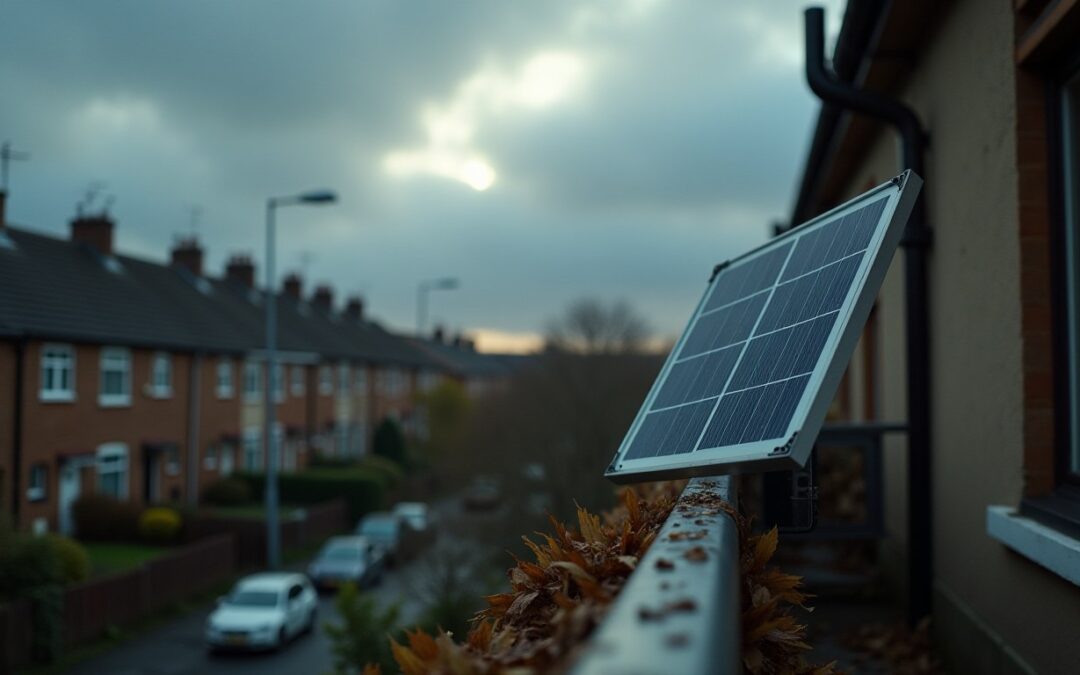
A plug-in solar panel is a large, flat, angled object fixed in an outdoor location — often in a garden, on a roof, or against a fence. In still conditions it sits quietly generating electricity. In a storm, it becomes a sail.
Wind is the most commonly underestimated risk with plug-in solar. People spend time thinking about which panel to buy and where to point it, and considerably less time thinking about what holds it in place when the weather turns. This is the article I wish more people read before installing.
What wind actually does to a panel
A 400W plug-in solar panel typically measures around 1.7 to 2 square metres. Picture that surface area tilted at 30 to 35 degrees, facing roughly south. Now imagine a 50mph gust — not unusual in the UK in autumn and winter — hitting it.
Two forces are at work simultaneously:
Lateral force: The wind pushes the panel sideways and backwards. On a ground mount, this tries to tip the whole frame over. On a fence mount, this pushes against the fence fixings and the fence posts.
Uplift: Wind flowing over the top surface of a tilted panel creates lower pressure above and higher pressure below — the same basic aerodynamics as a wing. This generates an upward force that tries to lift the panel off its mount. If the only thing holding it down is ballast weight, and the uplift exceeds that weight, the panel lifts.
In a severe gust these two forces combine. A panel that is inadequately secured can tip, rotate, or in the worst cases become airborne. A 20kg panel frame landing on a greenhouse, car, or person is a serious injury risk.
This is not hypothetical. There are documented cases across Europe of improperly secured balcony and garden solar panels failing in storms.
The four mounting types and their risks
Ballast-only ground mounts are the most common for plug-in solar. A frame sits on paving slabs or a flat surface, held down by weight — either the frame’s own weight distribution or added concrete blocks or sandbags.
The risk: ballast that is adequate for normal wind conditions may be insufficient for peak gust loads, particularly if the panel is at a steep angle or in an exposed location. As the angle of tilt increases, the uplift force increases. A panel at 45 degrees in an exposed garden needs significantly more ballast than the same panel at 20 degrees in a sheltered courtyard.
Anchored ground mounts use ground stakes, helical anchors, or concrete footings to physically fix the frame to the ground. This is substantially more secure than ballast alone and is recommended for exposed locations, steep tilt angles, or larger panel arrays.
Wall and fence mounts attach the panel to a vertical structure. The wall or fence carries the wind load, so its structural integrity matters enormously. A solid brick wall with properly installed brackets can handle a panel safely. A timber fence with ageing posts and a loose gravel board cannot.
Flat roof ballast mounts are common for shed and garage roofs. The panel sits on a frame weighted with ballast. The risk here is double: the panel can move, and the frame can also slide across the roof surface. Anti-slip matting under the frame helps, but proper ballast calculations are essential — and the roof itself must be capable of carrying the combined weight.
How to assess your location’s wind exposure
The UK Met Office uses a standard wind zone classification for construction purposes, but for practical plug-in solar purposes a simpler assessment is useful:
Sheltered: Surrounded by buildings, walls, or dense hedges on most sides. Wind speed is significantly reduced. Standard manufacturer ballast recommendations are likely sufficient.
Moderate: Typical suburban garden with some surrounding structures but open aspects on one or two sides. Standard ballast recommendations apply, but check the manufacturer’s guidance for your specific tilt angle.
Exposed: Open countryside, elevated ground, coastal locations, rooftops above surrounding buildings. Wind speeds can be significantly higher than ground level in a sheltered suburb. Add additional ballast beyond manufacturer minimums, or use anchored mounts. Coastal locations in particular experience severe gusts — if you can see the sea from your garden, treat your installation as exposed.
If you are unsure, stand in your garden on a windy day and note how much wind movement you experience compared to a sheltered spot. Your panels will experience the same conditions, elevated above the ground level obstructions.
The fence problem
Fence mounting is appealing because it points the panel south (if you have a south-facing fence) and uses existing structure. It is also one of the most common sources of mounting problems.
The issues:
Fence age and condition: Most UK garden fences are timber post and panel, typically 6 to 10 years old before they start to degrade. A fence that looks fine from a distance may have rotting posts at ground level or loose concrete collars. Adding the wind load of a solar panel to a fence in this condition is asking it to fail.
Shared boundaries: Many garden fences are on or near a boundary with a neighbour. If the fence is your neighbour’s responsibility, or on the boundary line, fixing a panel to it without their knowledge and consent is poor practice — and if it fails and damages their property, you are liable.
Panel angle on a vertical fence: A panel mounted flat against a vertical fence is at 90 degrees — generating only about 65% of the output of a tilted panel, but also presenting maximum lateral wind load to the fence. Bracket mounts that angle the panel outward from the fence improve output but increase leverage on the fixings.
If you want to fence-mount, use quality stainless steel brackets rated for outdoor use, fix into the posts rather than the panels, and be honest with yourself about the fence’s condition.
Signs your current mounting is inadequate
- The frame or panel visibly moves or vibrates in moderate wind
- Ballast blocks have shifted position since installation
- Cable tension has increased (cables have pulled taut rather than hanging loosely)
- The mount has moved position even slightly from where you originally placed it
- Your fence has started to lean since you attached the panel
Any of these means the mounting needs attention before the next storm, not after.
What a properly secured installation looks like
For a ground-mounted panel in a typical UK suburban garden:
- Frame is level and stable with no rocking on uneven surfaces
- Ballast weight meets or exceeds manufacturer specification for your tilt angle and exposure level
- Cables run in a gentle loop to the socket — no tension, no strain on the connector
- The frame cannot be lifted by one person without significant effort
- In an exposed location: ground anchors or stakes are used in addition to ballast
For a fence or wall mount:
- Brackets are fixed into posts or structural masonry, not into fence panels or render
- Fixings are stainless steel or galvanised — no ordinary zinc-plated screws
- The fence or wall has been assessed as structurally sound
- A second person has tried to move the panel after installation and found it solid
It takes ten minutes to do this assessment properly. It is ten minutes very well spent before the first autumn storm arrives.
A note on cable management in wind
One thing often overlooked: the cable that runs from your micro-inverter to the socket.
In wind, an unsecured cable flaps. Repeated flexing at the same point — particularly at the connector or where the cable passes through a wall or fence — causes fatigue damage. Over months, this can lead to insulation cracking or connector damage.
Secure the cable at intervals with outdoor-rated cable clips or ties. Leave a gentle service loop near the inverter so the panel can move very slightly without putting tension on the connection. And use a weatherproof socket cover on the exterior socket — water ingress into a socket that is also carrying solar generation is not something you want.
The bottom line
Plug-in solar is genuinely straightforward to install safely. But “straightforward” does not mean careless. A few extra minutes spent on mounting, a few extra kilos of ballast, and a quick structural check of whatever you are fixing to — these are the difference between a panel that generates electricity for years and one that ends up through a greenhouse window on a January night.
Fix it properly once. Then stop thinking about it.