Dirty solar panels lose output. Research consistently shows that a film of dust, bird droppings, and environmental deposits can reduce panel output by 5 to 20 percent — sometimes more on heavily soiled panels.
The good news for plug-in solar users is that UK panels rarely get as dirty as panels in dustier climates. Our frequent rainfall does a reasonable job of natural cleaning. But “reasonable” is not the same as “no maintenance needed,” and a quick clean at the right times of year can meaningfully improve your generation.
Here is how to do it correctly.
What makes panels dirty in the UK?
The main soiling sources on UK plug-in solar panels are:
Bird droppings — the most significant cause of output loss. A dropping covering 5% of a panel’s surface can reduce output by more than 5%, because of how solar cells interconnect. A concentrated dropping on a corner of the panel is less of a problem than one across the middle.
Airborne dust and pollution — a fine film that builds up gradually. In urban areas, traffic pollution is the main contributor. In rural areas, agricultural dust and pollen are more significant.
Algae and moss — in shaded or humid positions, green or black algae can establish on panel glass. This is more common in older installations in north-facing positions.
Lichen — rare but stubborn. Usually only appears on panels that have been installed for many years in very shaded, damp positions.
The simple hosepipe clean
For most UK plug-in solar panels, a hosepipe and plain water is all you need.
-
Wait for a cooler part of the day — early morning or late afternoon, not midday when panels are hot and producing electricity. Cold water on hot glass can cause thermal stress.
-
Use a low-pressure spray setting. A jet wash is not necessary and can damage cable glands, junction box seals, and frame connections.
-
Spray the panel surface from top to bottom, allowing water to run down and carry deposits off the bottom edge.
-
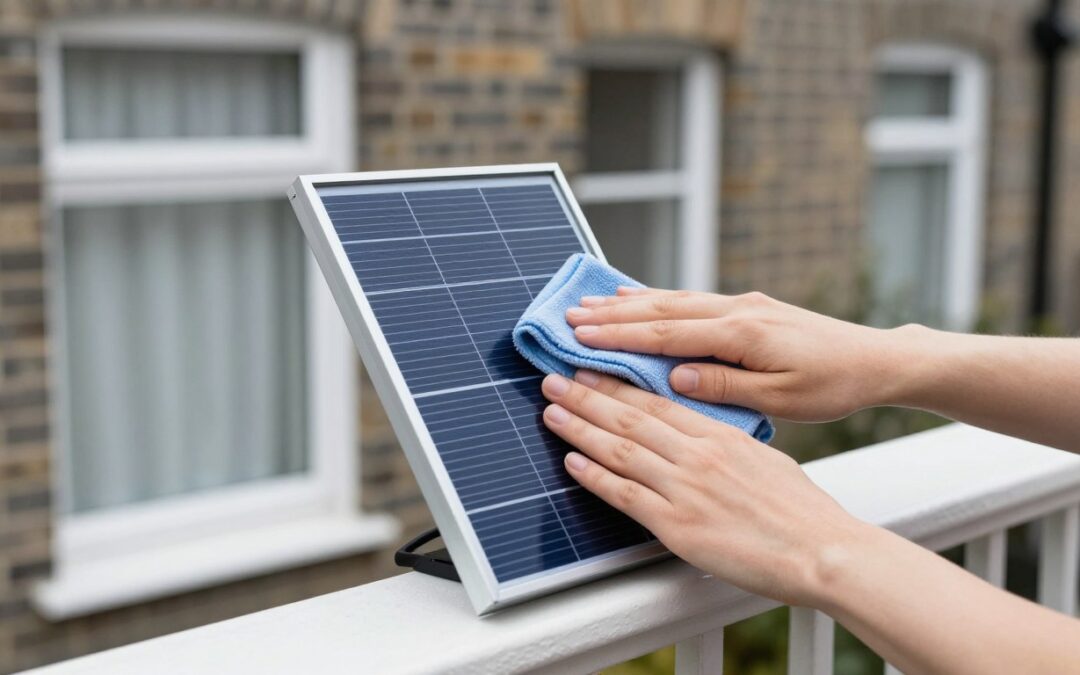
If there are stubborn deposits, a soft cloth or sponge soaked in water can be used to gently wipe the surface. Do not scrub.
-
Allow to dry naturally, or wipe down with a clean soft cloth if you want a streak-free result.
Dealing with bird droppings
Bird droppings should be removed as soon as you notice them, for two reasons: they reduce output immediately, and dried droppings are harder to remove without risk of scratching the glass.
Fresh droppings: A damp cloth is sufficient. Press gently and let the moisture soften the deposit, then wipe away.
Dried droppings: Soak with a wet cloth for a few minutes before attempting to remove. A small amount of washing-up liquid (one drop in a cup of water) helps soften stubborn dried deposits. Do not scrub dry — you will scratch the glass.
Algae and green staining: A dilute solution of white vinegar and water (1:10) applied with a soft cloth will dissolve mild algae. Rinse thoroughly afterwards. For persistent algae, purpose-made solar panel cleaning solution is available online — these are pH-neutral and will not damage panel coatings.
What not to use
Certain cleaning products and methods will damage your panels:
- Jet washers / pressure washers: Too much pressure for panel seals. The junction box at the back of the panel is not designed to be high-pressure-washed.
- Abrasive pads or scourers: Will scratch the glass surface and the anti-reflective coating.
- Bleach: Can degrade rubber seals and leave deposits that affect optical clarity.
- Acid-based cleaners (including strong vinegar solutions): Can attack the glass coating.
- Window cleaning squeegees with hard rubber: Can leave micro-scratches if used dry.
- Solvents (acetone, white spirit): Will damage the junction box plastic and seals.
The rule is: if it would damage your car’s paintwork or your kitchen window glass, it will damage your panel.
Cleaning mounted panels safely
Plug-in solar panels are typically accessible because of how they are installed — on a garden fence, shed roof, balcony rail, or freestanding frame at garden level. This is one of the advantages of plug-in solar over rooftop systems.
For panels at head height or below: clean from the ground with a hosepipe and a long-handled soft brush or mop if needed. No ladder required.
For panels on a shed or garage roof edge: only work from a stable ladder with a helper to steady it. Never lean across the roof surface. A long-handled tool (telescopic brush, window cleaning pole) is safer than working at height directly.
For balcony panels: the panel is typically already at hand height when standing on the balcony. Clean from the balcony surface, not from over the balcony rail.
How often?
UK panels typically need cleaning two to four times per year:
Late February or early March: Before the main generation season starts. Removes winter accumulation of algae, moss, and atmospheric deposits.
After any extended dry spell (typically June-August): A few weeks without rain allows dust and debris to accumulate noticeably. A clean before the dry spell breaks improves the summer generation peak.
Autumn (October): Before reduced daylight hours begin. Also a good time to check mounting hardware and cable connections.
After significant events: Tree pollen season (April-May) can leave a yellow film; construction dust nearby; a particularly messy period from roosting birds.
Monitoring your generation data makes cleaning timing easy. If your output drops noticeably on similar-weather days compared to recent weeks, a clean is due.
Checking while you clean
Cleaning is a natural time to inspect your installation:
- Frame and mounting: Any loose bolts or movement in the frame? Tighten now.
- Cables: No chafing, no damage, connectors are properly seated.
- Junction box (back of panel): No cracking, no signs of water ingress.
- Inverter: No error lights, LED showing normal operation.
- Panel glass: Any chips, cracks, or discolouration? A chipped panel edge is not necessarily a problem, but a crack across the glass is.
Most plug-in solar panels are designed for minimal maintenance, and the list above is a quick visual check, not a technical inspection. But catching a loose mount or a damaged cable connector early saves a bigger problem later.
The investment in cleaning time
A single cleaning session for a twin-panel setup takes 15 to 20 minutes. If you do it three times a year, that is an hour of your time — in exchange for maintaining peak output across a generation season that may run 8 to 9 months of the year.
The typical output improvement from cleaning moderately soiled panels is 5 to 10%. On an 800W setup generating 700 kWh per year, that is 35 to 70 kWh of extra generation, worth £9 to £18 at 25p. For 20 minutes of your time, three times a year.
Clean your panels. It is worth it.