
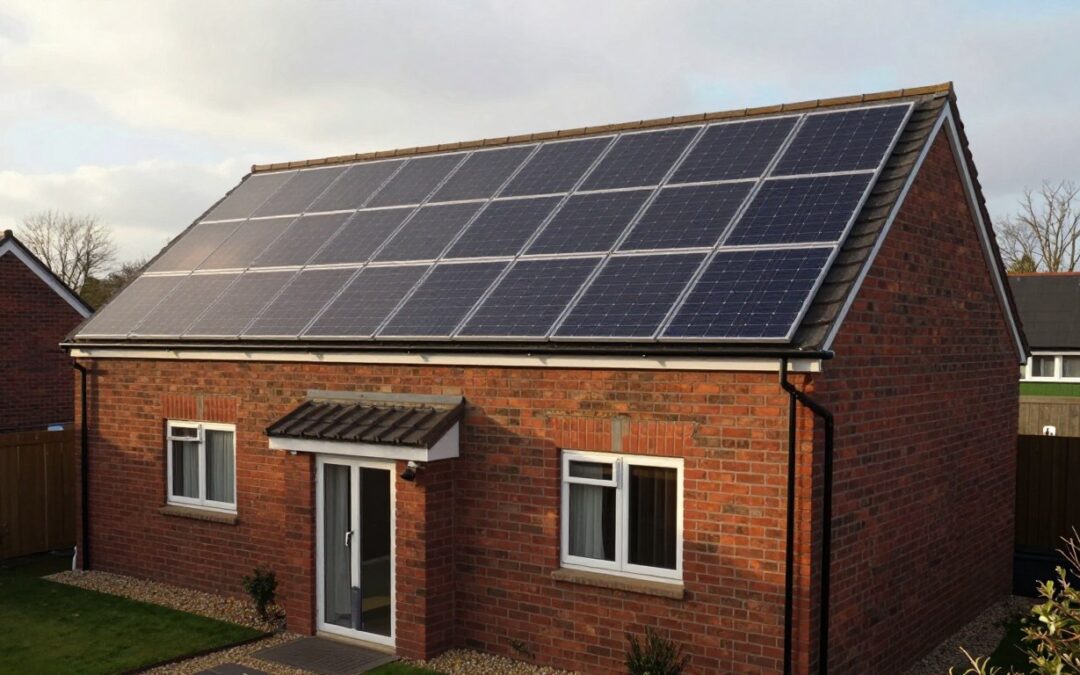
Ask most people where to point a solar panel and they will say south. They are right, in one sense. A south-facing panel at the correct tilt angle for your latitude will generate more kilowatt-hours per year than the same panel facing any other direction.
But “most kilowatt-hours per year” is not always the same as “most useful electricity.” For many UK households, the question is not just how much solar you generate — it is when you generate it relative to when you use it.
And on that measure, an east-west split can beat south. Here is why.
The south-facing panel problem
A south-facing panel at a 30 to 35 degree tilt generates the majority of its electricity in a relatively narrow midday window. On a clear summer day, generation ramps up from about 8am, peaks between 11am and 2pm, and drops off through the afternoon. Outside that peak, generation is modest.
For households where someone is home all day and can run appliances at midday, this is fine. The solar hits at exactly the moment when you want to run the dishwasher.
But for the majority of UK working households — out of the house between 8am and 6pm — the midday peak is largely wasted. Solar generates at noon when nobody is home and nothing is drawing power; the surplus flows back to the grid for nothing (since plug-in solar users cannot access the SEG). The household then draws from the grid in the morning getting ready and in the evening when everyone is back.
This is not a reason to avoid south-facing panels — you still save on your bill because your total grid draw is reduced. But it means a significant portion of your generation is not directly self-consumed, which reduces the effective value.
What east-west does differently
Split your two panels — one facing east, one facing west — and you change the generation profile dramatically.
The east panel generates well from sunrise to around noon, with a peak in the morning. If your household is active between 7am and 9am — showers, kettles, toasters, phones charging — your east panel is generating at exactly that time.
The west panel generates well from noon through to sunset, with a peak in the mid-to-late afternoon. When the school run happens at 3:30pm and the oven goes on at 5pm, your west panel is still generating.
The result is a flatter, broader generation curve. You generate less at peak, but generation is spread from early morning to late evening. And more of it happens at times when your household is actually consuming electricity.
Does the maths actually work?
Let us compare a twin-panel 800W setup in a typical UK working household — two adults, out from 8am to 6pm, active early morning and evening.
Both panels south-facing:
– Annual generation: ~750 kWh
– Self-consumption rate: ~35% (midday peak hits mostly empty house)
– Self-consumed: ~263 kWh
– Annual saving at 25p: ~£66
One east, one west:
– Annual generation: ~680 kWh (east and west each produce ~85% of south)
– Self-consumption rate: ~55% (morning and afternoon peaks align with household activity)
– Self-consumed: ~374 kWh
– Annual saving at 25p: ~£94
The east-west split generates less total electricity but saves more money — 42% more, in this example. The self-consumption rate does the heavy lifting.
These are illustrative figures — your actual results depend on your roof angles, local shading, and household pattern. But the direction of the effect is real and well-documented.
The inverter question
The practical challenge with an east-west split is that most plug-in solar micro-inverters are designed for panels on a single string, facing one direction. If you connect an east-facing and a west-facing panel to the same inverter, they will be generating at different times — and the inverter manages them as a single string, which creates inefficiency.
The clean solution is two separate micro-inverters, one per panel, each plugging into its own socket. This is exactly what you would get if you bought two single-panel kits rather than one twin-panel kit.
Some inverters (particularly newer models with dual-MPPT inputs) can handle two panels independently, tracking each one’s maximum power point separately. If you want an east-west split with a single inverter, look specifically for dual-MPPT capability.
Practical applications
Two-wall house: Many UK semi-detached and terraced houses have a side facing east and a side facing west, with fences or outbuildings on both sides. Mounting one panel on the east fence and one on the west fence is a clean east-west split, and both panels benefit from clear sky in their respective morning and afternoon windows.
Front and back garden: A north-south-oriented terrace often has a back garden facing one direction and a front elevation facing another. A panel on the back fence (south-facing, or south-west) paired with one on a shed roof facing east gives a reasonable spread, though not a perfect east-west.
Shed or garage: A shed with a pitched roof often has one slope facing roughly east and one roughly west. Two panels, one per slope, gives the east-west effect almost automatically.
When south-facing is still better
Not every household benefits from the east-west split.
If someone is home all day — working from home, retired, or caring responsibilities — the south-facing midday peak is directly useful. Appliances run at noon; the self-consumption rate is already high. An east-west split just reduces total generation without a self-consumption benefit.
If you have battery storage, the timing mismatch problem disappears. The south-facing midday peak charges the battery; the battery discharges in the evening. South-facing remains optimal for total generation.
Summary
South-facing maximises kilowatt-hours. East-west maximises self-consumption for a 9-to-5 household. The right answer depends on your pattern of electricity use.
If you are home during the day, go south. If you are out during the day and active in the mornings and evenings, consider the east-west split — and expect to save significantly more per unit generated, even though you generate fewer units overall.