
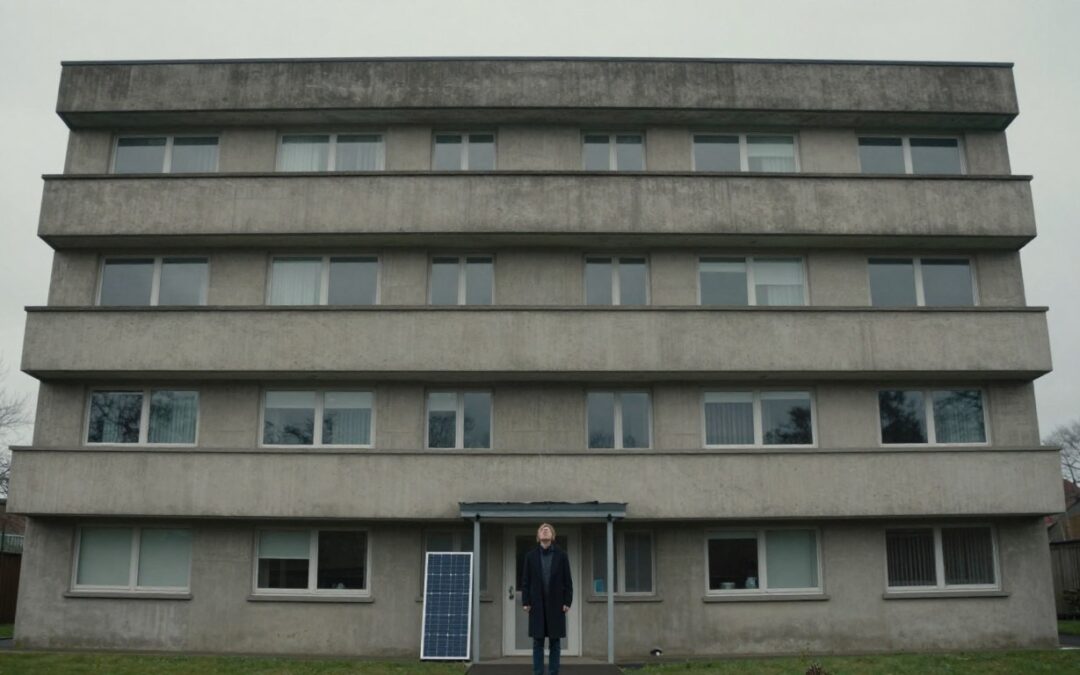
Renters get a lot of coverage in the plug-in solar conversation. Quite rightly — they face the same barriers as everyone else plus the additional one of needing landlord permission.
But there is a third category of people who face a distinct and often poorly understood set of barriers: leasehold flat owners. People who own their flat — who are paying a mortgage, who have a share of freehold or not, who definitely own their home — but who cannot simply attach something to the exterior of the building without going through a process that can be slow, expensive, and sometimes just futile.
This is the leasehold solar problem. It affects millions of UK households.
Why owning a flat is not the same as owning a house
When you buy a leasehold flat, you buy a long lease on a portion of the building — typically the airspace within your flat’s walls — for a fixed number of years. The freehold of the building itself (the land, the structure, the external walls, the roof, the communal areas) is held by someone else: the freeholder, often represented day-to-day by a managing agent or residents’ management company.
Your lease defines what you can do within your demised premises. In most UK residential leases, that does not include making structural alterations or attaching things to the external fabric of the building without permission. A solar panel mounted on a balcony rail, fixed to an external wall, or sitting on a flat roof above your flat’s ceiling — all of these touch the external structure of the building, which is the freeholder’s domain.
This is not unusual or wrong. Buildings need to be maintained coherently, and letting individual leaseholders do whatever they want to the exterior would create chaos. But it does mean you need permission, and getting it is not always straightforward.
What does your lease actually say?
The first step is to read your lease, specifically the alterations clause. This will typically say something like: “The Tenant shall not make any alterations or additions to the Property without the prior written consent of the Landlord, such consent not to be unreasonably withheld.”
The key words are “not to be unreasonably withheld.” This means your freeholder cannot simply say no without reason. They have to consider your request properly and either grant consent (possibly with conditions) or refuse with reasons.
Some leases are more restrictive — they prohibit certain alterations outright, without any provision for consent. If your lease absolutely prohibits external alterations and gives no mechanism for consent, you have a harder problem, though even then it may be worth a conversation with a solicitor.
The process: asking for a licence to alter
If your lease allows alterations with consent, you need to apply formally for a licence to alter. This is a written document from your freeholder granting permission for a specific change.
In practice, this usually means:
-
Write to your managing agent or freeholder describing what you want to install: the type of panel, the mount, how it will be attached, and confirming it can be removed without damage if you sell.
-
Your freeholder will likely consult their buildings insurance provider, their structural engineer if they have concerns about loading, and possibly the management committee if it is a residents’ management company.
-
They may grant consent outright, grant it with conditions, or refuse with reasons.
-
If they refuse unreasonably, you have legal options — but those cost money and take time.
Freeholders can charge a fee for granting a licence to alter. Legally, this should be reasonable. In practice, fees vary enormously — some charge nothing, others charge hundreds of pounds. The Leasehold and Freehold Reform Act 2024 introduced some limits on these charges but the situation is still not ideal.
What counts as a reasonable refusal?
Freeholders and management companies have legitimate concerns around:
Structural loading. A solar panel on a balcony adds weight. For most plug-in panels (typically 20-25kg per panel), this is unlikely to be structurally significant on a properly constructed balcony, but a freeholder is entitled to ask for confirmation.
Aesthetics and uniformity. Many residential blocks have covenants or planning conditions requiring a consistent external appearance. If you install solar panels and your neighbour wants to paint their front door a different colour, both arguably affect the building’s appearance. Freeholders can impose conditions about the type and appearance of panels.
Buildings insurance. Some insurers have questions about modifications to buildings. A freeholder may need to notify their insurer and could face a premium increase, which they would want to recover.
Safe access. If the panel needs maintenance or removal, and that requires access to communal areas, the freeholder can require conditions about how that happens.
None of these concerns are unreasonable. But a blanket “no” without engaging with your specific proposal is much harder to justify, and if you push back — in writing, citing your lease terms — many managing agents will reconsider rather than risk a formal dispute.
The balcony: is it part of your flat?
One thing to check carefully is how your balcony is defined in your lease. In some UK residential leases, a balcony is part of the demised premises — it is included in the floor plan of what you have bought and is yours to use exclusively. In others, the balcony is classified as common property, with exclusive use rights granted to the adjoining flat.
The distinction matters. If the balcony is part of your demised premises, you have a stronger argument that you can use it as you see fit (subject to the alterations clause). If it is common property with a licence for your exclusive use, your rights are more restricted.
Your lease should include a plan of the demised premises, and the balcony will either be within those hatched areas or outside them. If it is not clear, a solicitor can give you a view for a relatively modest fee.
What about permitted development?
The UK planning system introduced a new permitted development right for plug-in solar (balcony solar) for most properties in August 2026. For standard houses, this means you can install panels without applying for planning permission.
For flats and leasehold properties, the picture is more complicated. Planning permission is one thing; leasehold consent is another. Even if permitted development applies to your building (which it may not if you are in a conservation area, a listed building, or have an Article 4 direction in force), you still need your freeholder’s consent under your lease.
Planning and lease consent are separate regimes. Winning one does not help with the other.
Collective solar: the building-wide option
If you are getting nowhere with individual balcony consent, there is a more powerful alternative: collective solar for the whole block.
A growing number of residential blocks are installing solar panels on their roof as a communal system, with the benefits shared among all residents. This typically requires:
- A majority vote of leaseholders in the building (and the management company’s agreement)
- A surveyor’s report on the roof’s structural suitability
- Installation by a certified contractor
- An arrangement for distributing generated electricity to residents (usually via a reduction in service charges, or via a power purchase agreement)
This is not a quick fix — it requires collective action and buy-in from your neighbours. But it bypasses the individual consent problem entirely and delivers meaningful savings to everyone in the building. If you are in a block with engaged residents and a cooperative management company, it is worth exploring.
Your practical options, ranked
-
Check your lease and ask formally — it costs nothing and some freeholders will say yes, especially if you present it well and address their likely concerns upfront.
-
Make it as easy as possible to say yes — choose panels that are lightweight, mount without penetrating the structure, and can be removed cleanly. Freestanding balcony mounts are more likely to get approval than wall-fixed brackets.
-
Use the landlord template on this site — the letter to your landlord template works for freeholders too, adapted for a formal licence to alter request.
-
Consider a portable setup — a free-standing panel on your balcony that is not mounted or fixed may not require consent at all, since it is not structurally attached to the building. Check your lease’s wording, but some leaseholders have successfully operated plug-in solar this way without formal consent.
-
If you are refused unreasonably, escalate — the First-tier Tribunal (Property Chamber) handles leasehold disputes and can rule on whether a refusal to consent was unreasonable. It is not a fast process, but the existence of the route gives you leverage in negotiations.
The leasehold solar situation in the UK is genuinely improving. It was barely discussed before 2025; it is now specifically on the government’s radar. Change takes time but it is coming.