
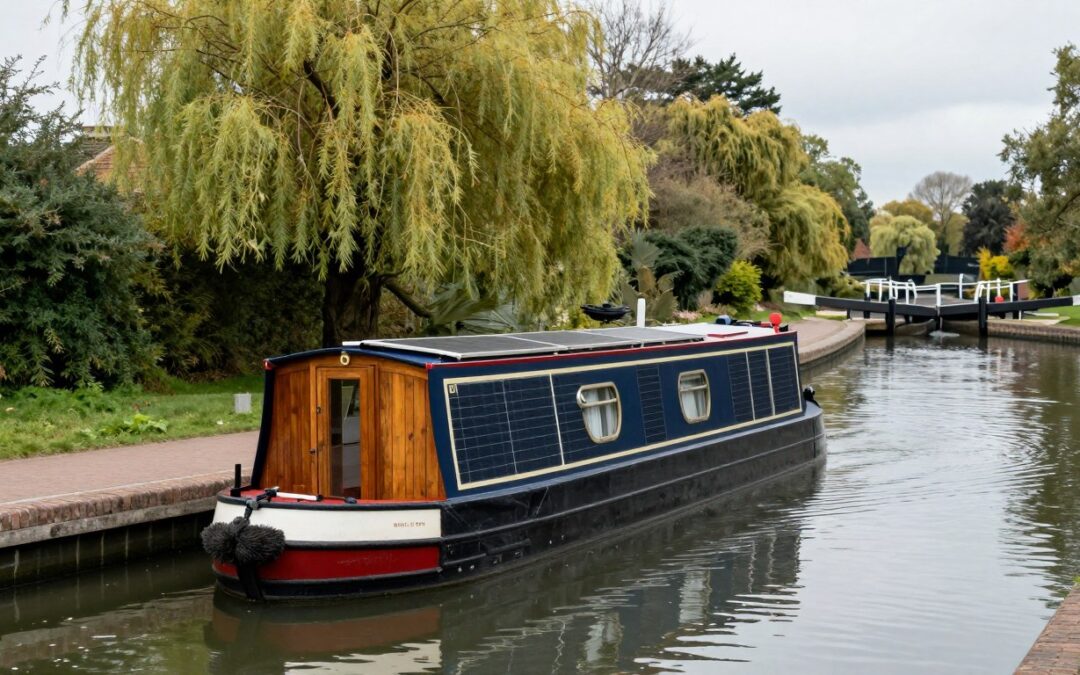
Narrowboats and solar are an obvious match. Moored in open water with roof space facing the sky and no planning permission required. The question is whether SI 2026/848 — the UK’s new plug-in solar legislation — applies to boats at all, and what the practical setup actually looks like.
Do the UK plug-in solar rules apply to narrowboats?
No. SI 2026/848 covers the connection of microgenerators to the public electricity network through a dwelling’s fixed wiring. A narrowboat is not a grid-connected dwelling in the regulatory sense. Most narrowboats run from diesel generators, shore power at marinas, or their own battery banks. A plug-in solar system on a narrowboat connects to the boat’s own system, not to the distribution network. The G98 grid-connection rules, the one-per-household limit, and the IPS certification requirements are all written for grid-connected residential properties and do not apply.
What the practical setup looks like
Most narrowboat solar installations use panels feeding into an MPPT charge controller and leisure battery bank. A typical setup: 12V or 24V DC system, panels on the roof, a quality MPPT controller, a leisure battery bank, and a 240V pure sine wave inverter for AC appliances. This predates the residential plug-in solar framework entirely.
If you want to use an EcoFlow STREAM battery on a narrowboat, it works as a standalone off-grid unit — panels into the STREAM’s MPPT inputs, battery charges from solar, appliances run from the STREAM’s own AC outlets. The grid-feed function is irrelevant. The Hoymiles HMS-800 is grid-tied by design and requires a live AC mains connection — not suitable for a narrowboat without shore power. EcoFlow STREAM units are the better choice for off-grid liveaboard use.
How much power from narrowboat solar
A 57-foot narrowboat roof has around 18 to 22 square metres of usable area. Four 400W panels fit in landscape orientation, giving 1,600W of panel capacity. In summer with good orientation, that produces 8 to 12 kWh per day — enough for LED lighting, a 12V fridge, laptops, phone charging, and television. 200 to 400Ah of leisure battery capacity (2.4 to 4.8 kWh at 12V) with a quality MPPT controller is the standard liveaboard solar-primary specification.
For the EcoFlow STREAM operating without a grid connection, see the off-grid section of our EcoFlow STREAM FAQ.